
Logistics Cost Reduction Strategies
Most logistics cost problems aren't solved by finding a cheaper carrier. They're solved by building better systems. That's a meaningful distinction, because chasing the lowest rate on a single lane is a tactic. Reducing your total cost to serve is a strategy.
Total cost to serve captures everything: transportation, warehousing, inventory carrying costs, accessorials, returns, damage, and the labor it takes to manage all of it. When you optimize only one piece in isolation, you often shift costs elsewhere rather than eliminate them. The companies that create durable logistics savings are the ones that treat the whole system as the lever.
This guide covers the full range of logistics cost reduction strategies, from transportation and warehouse operations to technology, procurement, and the metrics that tell you whether your savings are actually sticking.
Benefits and Strategic Importance of Cost Management
Cost management in logistics is often treated as a finance exercise. In practice, it's an operational discipline, and when it's done well, it becomes a competitive advantage.
Protect margins while maintaining service levels
Logistics is one of the few cost categories large enough to materially affect operating margins. In many B2B and manufacturing environments, transportation and warehousing together represent 8–12% of revenue. Small improvements compound quickly. A 10% reduction in freight cost on a $10M spend base is a million dollars, and unlike revenue growth, it drops straight to the bottom line.
The key is protecting service levels in the process. Cost cuts that lead to late shipments, stockouts, or damaged freight don't save money; they redistribute it into customer penalties, expedited recovery shipments, and lost business. The goal is cost efficiency, not cost reduction at any price.
Improve agility during volatility
The logistics market has repeatedly shown, through the pandemic capacity crisis, port-congestion cycles, and regional weather events, that supply chains reward preparation. Organizations with lean, well-managed logistics operations adapt faster. They have better carrier relationships to call on in a crunch, cleaner data to make decisions with, and lower baseline costs that give them more room to absorb a spike in spot rates without a budget crisis.
Companies that only focus on cost when the market is loose end up scrambling when it tightens
Cost management as a competitive advantage
The most important reframe here: logistics cost management isn't a one-time project. It's an ongoing operating discipline. Companies that treat it that way, building it into their planning cycles, review cadences, and technology infrastructure, don't just save money. They build capability that competitors struggle to replicate quickly. That's where cost management crosses from an operational function into a strategic one.
Key Drivers of Transportation and Logistics Costs
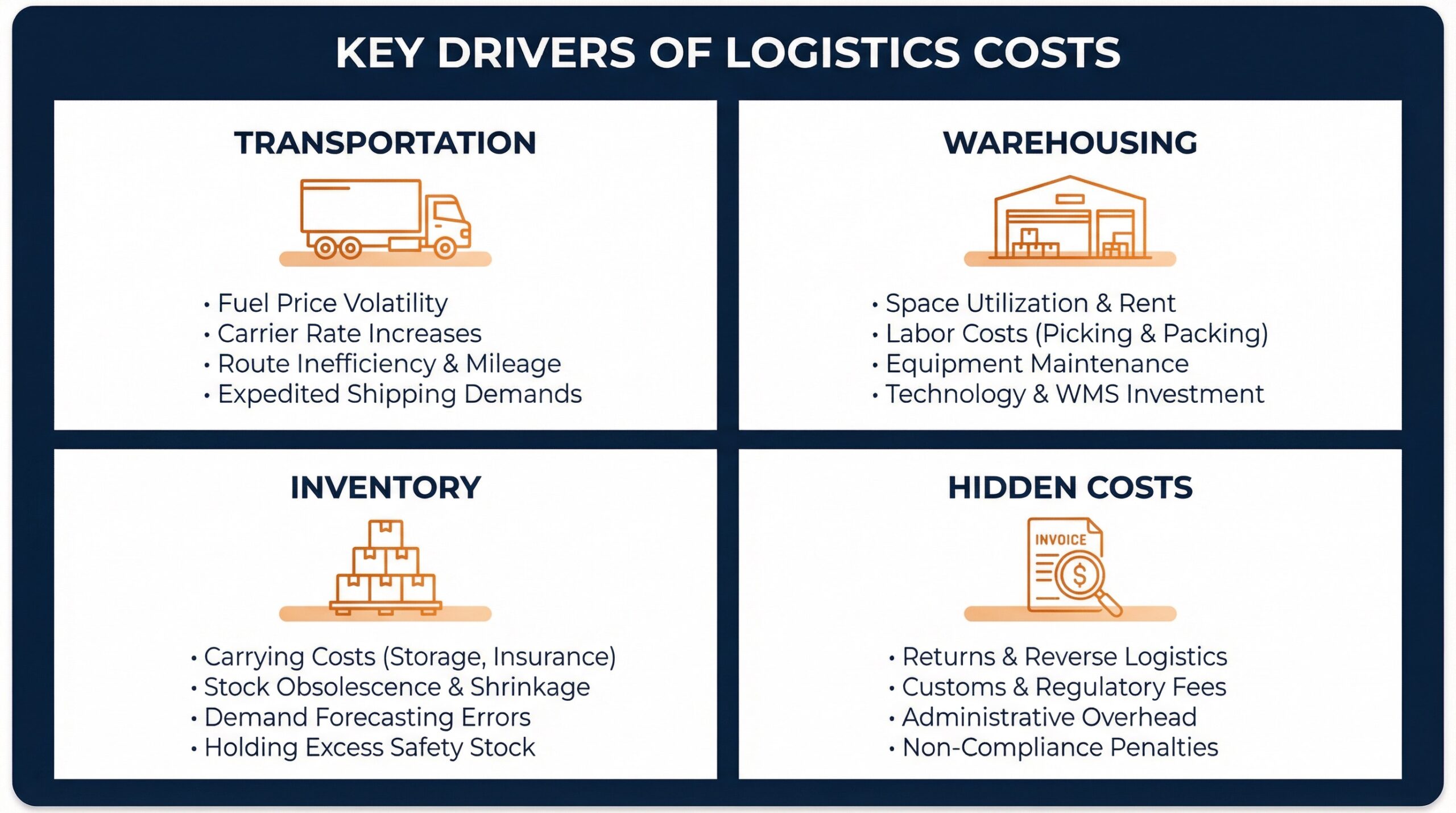
Before you can reduce costs, you need to understand what's actually driving them. Most organizations have a rough sense of their freight bill, fewer have a precise picture of where the money is going and why.
Transportation cost drivers
Mode selection is the biggest lever. LTL versus truckload, parcel versus regional carrier, air versus ocean — these are decisions that carry enormous cost implications, and they often get made reactively rather than strategically. Fuel, distance, and weight/cube efficiency are the next tier. Beyond those, carrier mix (contract versus spot), lane-level density, and load frequency all shape your per-unit moving cost.
Warehousing cost drivers
Labor typically accounts for 50–70% of warehouse operating costs. The next-largest driver is space, both the cost of space itself and its utilization efficiency. After that: equipment, utilities, and the cost of errors (mis-picks, mis-ships, returns processing). Many warehouse cost problems are really throughput problems in disguise: when operations slow down, the cost per unit moved goes up.
Inventory cost drivers
Carrying costs, the cost of holding inventory, are frequently underestimated. When you factor in capital tied up in inventory, insurance, shrinkage, and obsolescence costs, most companies pay 20–30% of inventory value annually just to hold it. Excess safety stock, poor demand forecasting, and slow-moving SKUs are the usual culprits. The result is working capital tied up in inventory that could be deployed elsewhere.
Hidden costs most teams overlook
Accessorial charges are the classic example. Detention, liftgate fees, residential delivery surcharges, and address corrections appear on invoices but are rarely scrutinized with the same level of discipline as base freight rates. The same is true for claims costs, which are often absorbed by customer service or accounting rather than traced to root causes in the warehouse or carrier selection process. Admin overhead, the labor cost of managing exceptions, disputes, and manual processes, is another cost that rarely shows up in a logistics budget but is very real.
Transportation and Logistics Cost Reduction Strategies
Right-size your service levels
Not every shipment needs two-day service. Not every lane warrants a dedicated carrier relationship. One of the highest-return questions in logistics cost management is: Are we buying more service than the customer actually requires?
Segmenting shipments by service requirement and routing each segment to the most cost-effective mode and carrier that still meets the requirement is foundational. This doesn't mean cutting service indiscriminately. It means being deliberate about when premium service is worth the premium cost, and when it isn't.
Improve utilization through consolidation and smarter planning
Empty space in a truck or container is money you've already paid for and can't recover. Load optimization (maximizing cube and weight utilization on every move) has a direct and immediate impact on cost per unit. Shipment consolidation (combining smaller shipments into full loads, using pool distribution, or coordinating multi-stop truckloads) compounds those impacts.
On the planning side, order lead time is a major lever—short lead times force reactive, expensive transportation decisions. Building even a few extra days of lead time into your order cycle creates more options, and more options almost always mean lower cost.
Reduce accessorials by attacking dwell time and execution gaps
Detention charges are one of the most controllable cost items in most freight budgets, and one of the most commonly ignored. Carriers charge detention fees when trucks are idle at the dock instead of moving. That's almost always an operational problem: appointments that aren't honored, staging areas that aren't ready, dock labor that's overstretched.
Auditing your accessorial spend by charge type and lane is a useful starting point. The patterns typically point clearly to the root causes, and the fixes are usually operational, not contractual.
Procurement and sourcing optimization
Carrier contract discipline matters more than most shippers realize. Rates negotiated two or three years ago may no longer reflect current market conditions, your current volume, or your current lane profile. Regular RFP cycles, even in markets where you're satisfied with your carriers, create competitive pressure and surface new options.
Beyond rates, contract structure matters. Minimum volume commitments, fuel surcharge mechanisms, and accessorial schedules all have significant cost implications that can be negotiated. Many shippers focus on the base rate and leave meaningful savings on the table elsewhere in the contract.
For 3PL relationships, benchmarking is the equivalent discipline. Activity-based pricing, gainshare arrangements, and regular performance reviews keep service providers aligned with your cost objectives over time.
Supply chain visibility and risk management
Visibility is an investment in cost avoidance. When you can see where inventory is and where shipments stand in real time, you can intervene before exceptions become expensive. You expedite less. You make fewer emergency procurement decisions. You absorb disruptions with less damage.
For many complex supply chains, the cost of visibility technology is often lower than the cost of expedites, inventory imbalances, and service failures that come from operating without it. Start with the highest-value lanes and expand from there.
Warehouse and Inventory Management Optimization
Reduce touches and travel time
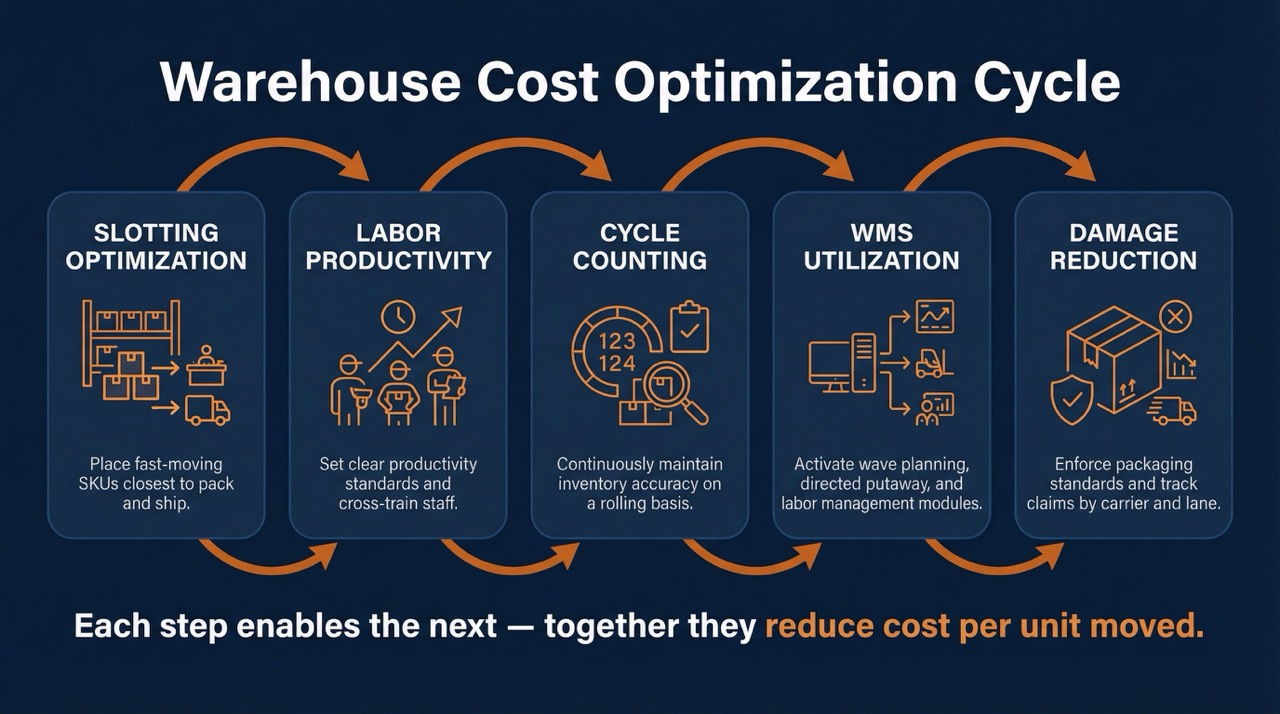
Every time a product is touched in a warehouse, it costs money. Every step a picker takes is labor that doesn't add value. Slotting (placing fast-moving SKUs close to pack and ship areas, and grouping frequently co-picked items together) is one of the simplest and highest-ROI warehouse improvements available. It requires no capital investment and can deliver double-digit gains in labor productivity.
Reviewing slotting on a regular cadence (seasonality and volume patterns change) keeps the gains from eroding over time.
Labor productivity without burnout
Warehouse labor is expensive and, in many markets, hard to find. Productivity standards, when set fairly and tracked transparently, provide teams with clear targets and help managers identify where coaching or process improvement is needed. The distinction between productivity pressure and burnout is real and matters for retention, which has high costs.
Cross-training and flexible staffing models help absorb volume variability without over-staffing to the peak. Temporary labor programs, when managed well, extend that flexibility further.
Inventory accuracy and cycle counting
Inventory accuracy is a prerequisite for almost everything else in warehouse efficiency. When location accuracy is poor, pickers spend time searching rather than picking. When system quantities don't match physical quantities, you end up with phantom stockouts or excess that sits and ages.
Cycle counting — counting a portion of inventory on a rolling basis rather than one massive annual physical — is a more effective approach for most operations. It keeps accuracy continuously maintained rather than relying on a once-a-year correction.
Use WMS capabilities and real-time inventory discipline
Most WMS platforms are underutilized. Wave planning, directed putaway, yard management, and labor management modules often go unconfigured or under-adopted after the initial implementation. Periodically reviewing how much of your WMS you're actually using and where gaps exist often surfaces productivity improvements that don't require any additional investment.
Real-time inventory discipline, such as scanning at every move, confirming putaway, and closing work orders accurately, is the foundation that makes everything else reliable. It's an operational habit, not a technology problem.
Cut damage, returns, and claims
Damage has a compounding cost: the product itself, the labor to process the return, the carrier claim process, and the cost of replacing the order. Packaging standards, training on proper handling, and disciplined load configuration are the first line of defense. Tracking claims by carrier, lane, and product type helps surface patterns, and those patterns often point to root causes that can be fixed systematically.
Leveraging Technology and Automation
TMS discipline for repeatable savings
A transportation management system creates structure around decisions that otherwise get made ad hoc. Rate shopping, carrier selection, load tendering, freight audit, and reporting — when these run through a TMS consistently, you get repeatable outcomes. The savings aren't from the technology itself; they're from the discipline the technology enforces.
For shippers without a TMS, the threshold to justify one is lower than it used to be. Cloud-based platforms have made enterprise-grade TMS functionality accessible at most spend levels.
Automation quick wins that typically pay back fastest
Not all automation projects are created equal. The fastest payback typically comes from: freight audit and payment automation (catches billing errors and eliminates manual invoice processing), carrier rate shop automation (ensures the lowest compliant rate is selected on every shipment without human intervention), and document automation (auto-generating BOLs, packing lists, and ASNs reduces errors and speeds processing time).
These projects don't require major systems overhauls and often connect to existing platforms through APIs or EDI. They're worth prioritizing before larger, longer-horizon automation investments.
Data quality and dashboards
Logistics cost programs stall when the data isn't trusted. If your cost-per-shipment numbers change depending on who pulls the report, or if the team spends more time reconciling data than acting on it, the underlying data infrastructure needs attention before anything else will work well.
Clean, consistent data and dashboards that make key metrics visible to the right people are often what separate a logistics organization that reacts to problems from one that sees them coming early.
Measuring and Monitoring Cost Reduction Success
KPIs that balance cost and service
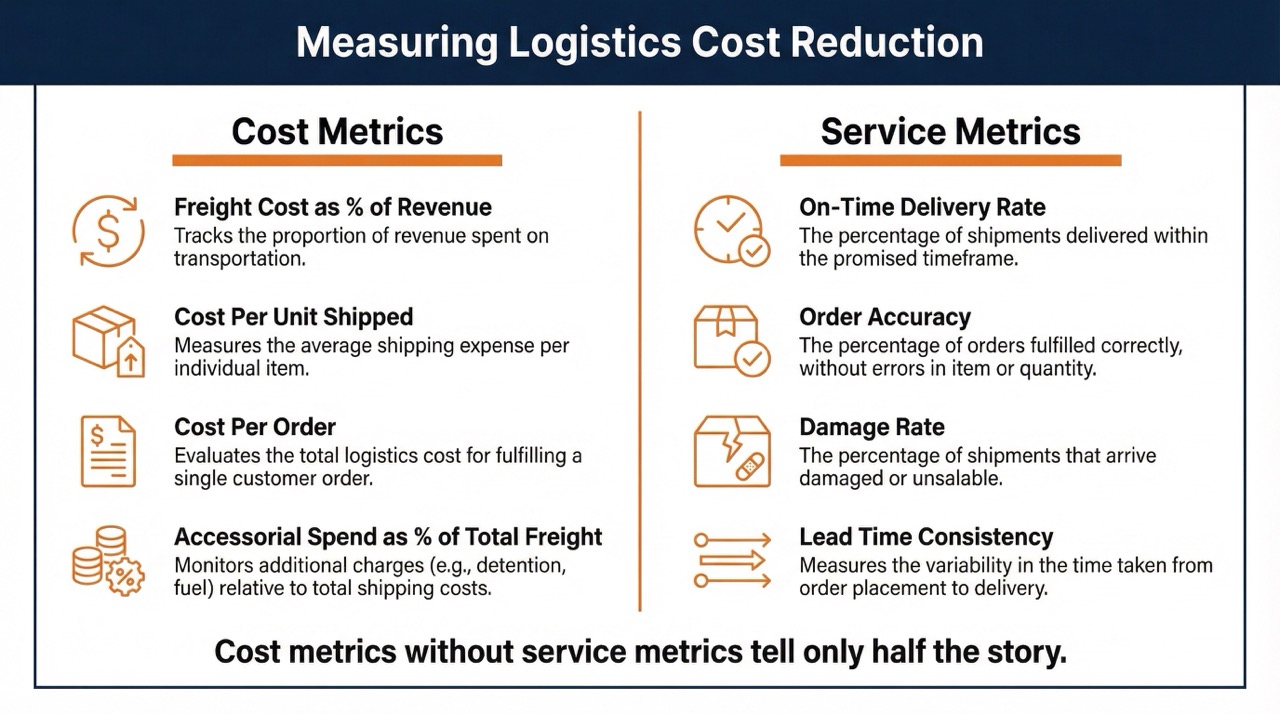
Cost metrics in isolation are dangerous. Cost per shipment going down while on-time delivery is deteriorating isn't progress; it's a trade-off. The right measurement framework tracks both dimensions simultaneously.
Core cost metrics: freight cost as a percentage of revenue, cost per unit shipped, cost per order, accessorial spend as a percentage of total freight. Core service metrics alongside them: on-time delivery, order accuracy, damage rate, and lead time consistency. Together, these tell a complete story.
Operating cadence that sustains savings
One-time cost reduction projects are common. Sustained cost management is rarer — and more valuable. The difference is cadence: regular reviews of key metrics, standing meetings between logistics, procurement, and finance, and a clear process for identifying and acting on variances.
Weekly operational reviews, monthly cost performance reviews, and quarterly carrier and 3PL business reviews create the rhythm that keeps cost management active rather than episodic.
Avoid the common failure modes
A few patterns reliably undermine logistics cost programs. Optimizing a single cost element without accounting for downstream effects (e.g., cutting safety stock to reduce carrying cost, then paying for expedited freight when stockouts occur). Measuring savings against the budget rather than against a neutral baseline, which can make cost increases look like savings if the budget was set conservatively. And treating cost reduction as a one-time initiative that gets handed off to the team after the project ends, rather than building it into how the organization operates day to day.
Putting It Together
Logistics cost reduction is not a single project. It is a set of disciplines applied consistently across transportation, warehousing, inventory, technology, and procurement. Over time, those disciplines compound into a meaningful structural advantage.
The organizations that do this well do not start by looking for the cheapest option. They start by understanding their total cost structure, identifying the highest-impact opportunities, and building the systems and habits that keep costs moving in the right direction over the long term.
If you are looking for a partner to help assess where your logistics costs are coming from and where the real opportunities are, Alpha Zero Logistics works with shippers across industries to build cost reduction strategies that hold up over time, not just at launch. Reach out to start the conversation.