
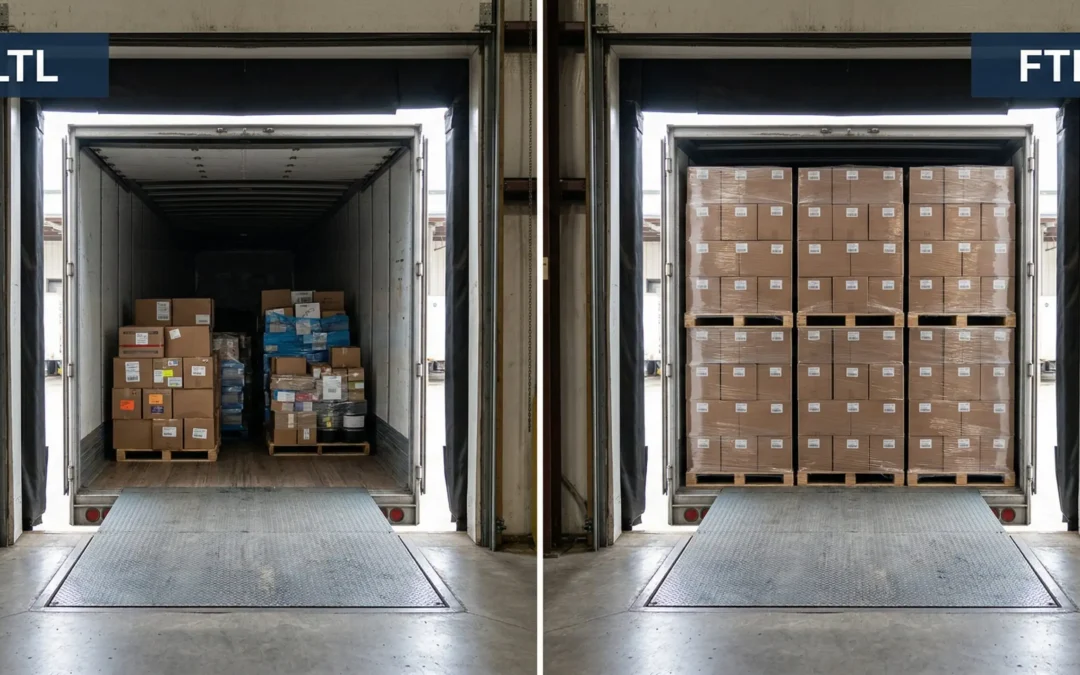
TL;DR: Less-than-truckload (LTL) shipping lets you share trailer space and pay only for the portion you use—ideal for shipments between 1 and 6 pallets. Full truckload (FTL) shipping reserves an entire trailer for your freight, delivering faster transit times and less handling—best for large or time-sensitive loads. The right choice depends on shipment size, freight characteristics, delivery deadlines, and budget goals. Below, we break down the costs, operational differences, and real-world use cases to help you make a confident decision.
LTL vs FTL Shipping: Costs, Pros & Use Cases
If you manage a supply chain, you’ve almost certainly faced this question: Should I ship LTL or FTL? The answer can mean the difference between meeting a delivery window and missing it—or between staying on budget and blowing past it.
LTL (less-than-truckload) shipping consolidates LTL freight from multiple shippers into a single trailer, so you only pay for the space your pallets occupy. FTL (full truckload) shipping reserves an entire 53-foot trailer exclusively for your goods, regardless of how much space you fill.
With rising freight costs, missed delivery windows, and tighter capacity squeezing margins, choosing the wrong shipping mode can ripple through your operation. In this guide, we break down the key differences, pricing structures, and real-world scenarios so you can ship smarter.
At Alpha Zero Logistics, we navigate these decisions daily. If you’d rather talk it through now, contact our logistics team—otherwise, read on for the full breakdown.
Key Differences Between LTL and FTL
LTL and FTL differ across six core dimensions: capacity, transit time, handling frequency, damage risk, scheduling flexibility, and cost predictability.
Here’s how the two modes compare.
| Factor | LTL | FTL |
| Capacity | 1–6 pallets (150–15,000 lbs) | Full trailer (15,000–45,000 lbs) |
| Transit Time | 3–7 business days (hub-and-spoke) | 1–3 business days (direct) |
| Handling Touches | Multiple (5–6 typical) | Minimal (load once, unload once) |
| Damage Risk | Higher due to rehandling | Lower—freight stays on one trailer |
| Scheduling | Carrier-driven windows | Flexible pickup and delivery |
| Cost Model | Per-hundredweight + freight class | Flat rate per mile or per load |
Industry data show that LTL freight damage ratios typically range from 1% to 2% of shipments, compared to significantly lower rates for FTL, where freight stays on one trailer from origin to destination (Olimp Warehousing). We’ve seen this firsthand: when our clients switch high-value or fragile shipments to FTL, claims often drop dramatically.
Pricing and Cost Structure (How Each Mode Is Charged)
Understanding how LTL and FTL pricing works helps you forecast freight spend more accurately and avoid surprise charges.
How LTL Pricing Works
LTL rates are calculated using a combination of shipment weight, dimensions, distance, and freight class—a standardized classification set by the National Motor Freight Traffic Association (NMFTA). Dense, easy-to-handle items fall into lower classes and cost less to ship, while lighter or bulkier goods sit in higher classes with steeper rates.
Accessorial fees can add up quickly. Liftgate delivery, residential pickup, inside delivery, and appointment scheduling each carry additional charges. Accurate measurement of weight and dimensions is critical—carriers increasingly use dimensioning technology to audit shipments and apply reclassification fees (C.H. Robinson).
Recent changes to the NMFC classification system make accuracy even more important. As Mark Davis, VP of Pricing and Traffic at Averitt, noted, simplifying freight classification should ultimately reduce friction between shippers and carriers (The Supply Chain Xchange).
How FTL Pricing Works
FTL pricing is more straightforward. You pay a flat rate based on mileage, equipment type (dry van, flatbed, or reefer), fuel costs, and market demand. Freight class is irrelevant because you’re buying the entire trailer. Average FTL rates range from $2.50 to $3.50 per mile including fuel, though contract rates can be lower for committed volume (Fortune Carriers).
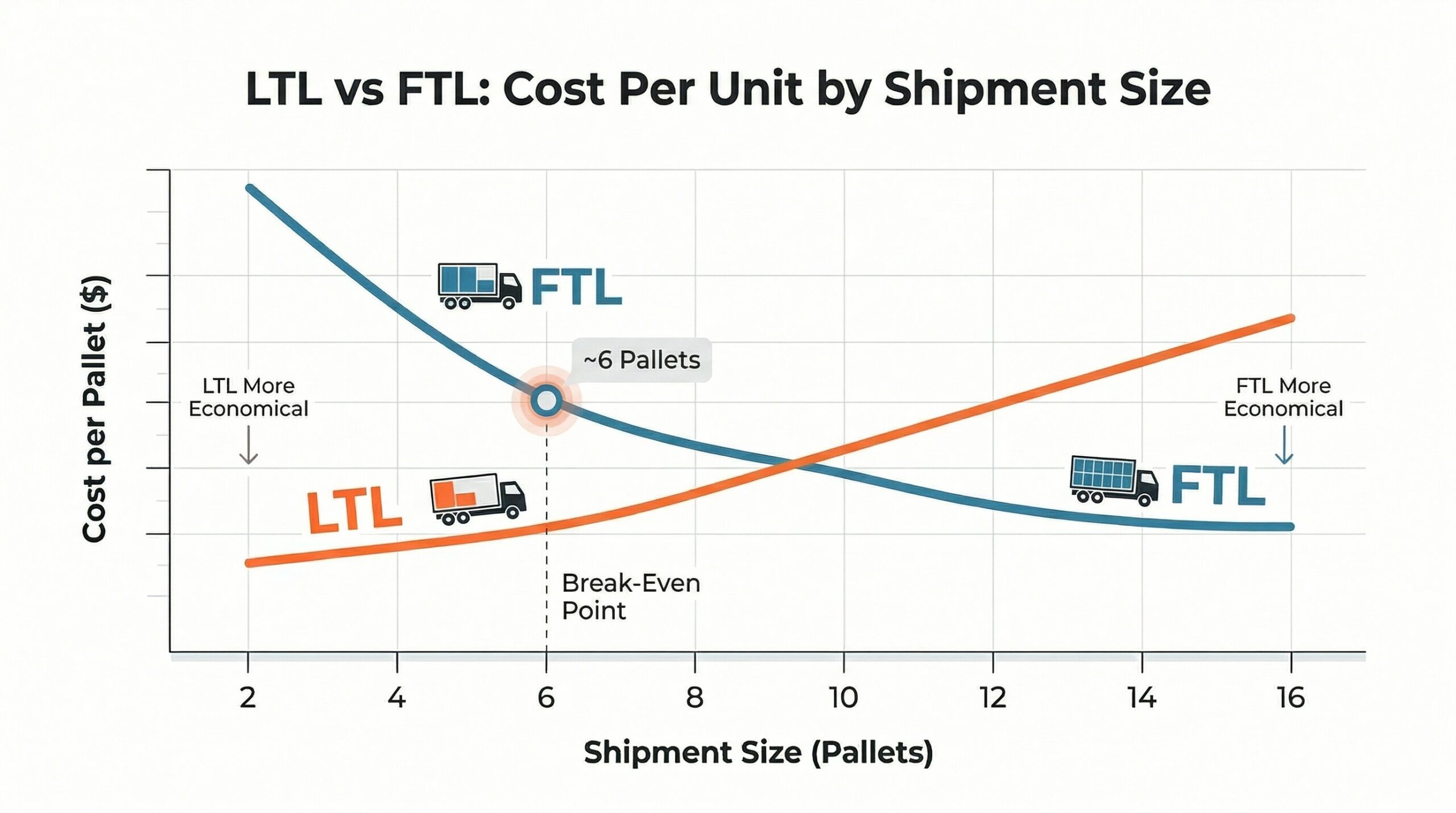
Cost-Per-Unit Thinking
Here’s a principle we emphasize with our clients: don’t just compare the invoice—compare the total landed cost. Factor in transit time, damage risk, accessorial fees, and detention charges. An LTL shipment may look cheaper on paper, but if it arrives late or damaged, the true cost is much higher. When your shipment fills more than half a trailer, FTL often delivers better per-unit value.
Operational Processes and Routing (What Actually Happens to Your Freight)
The way your freight physically moves through the network is the biggest driver of transit time, handling frequency, and damage risk.
LTL Network Flow
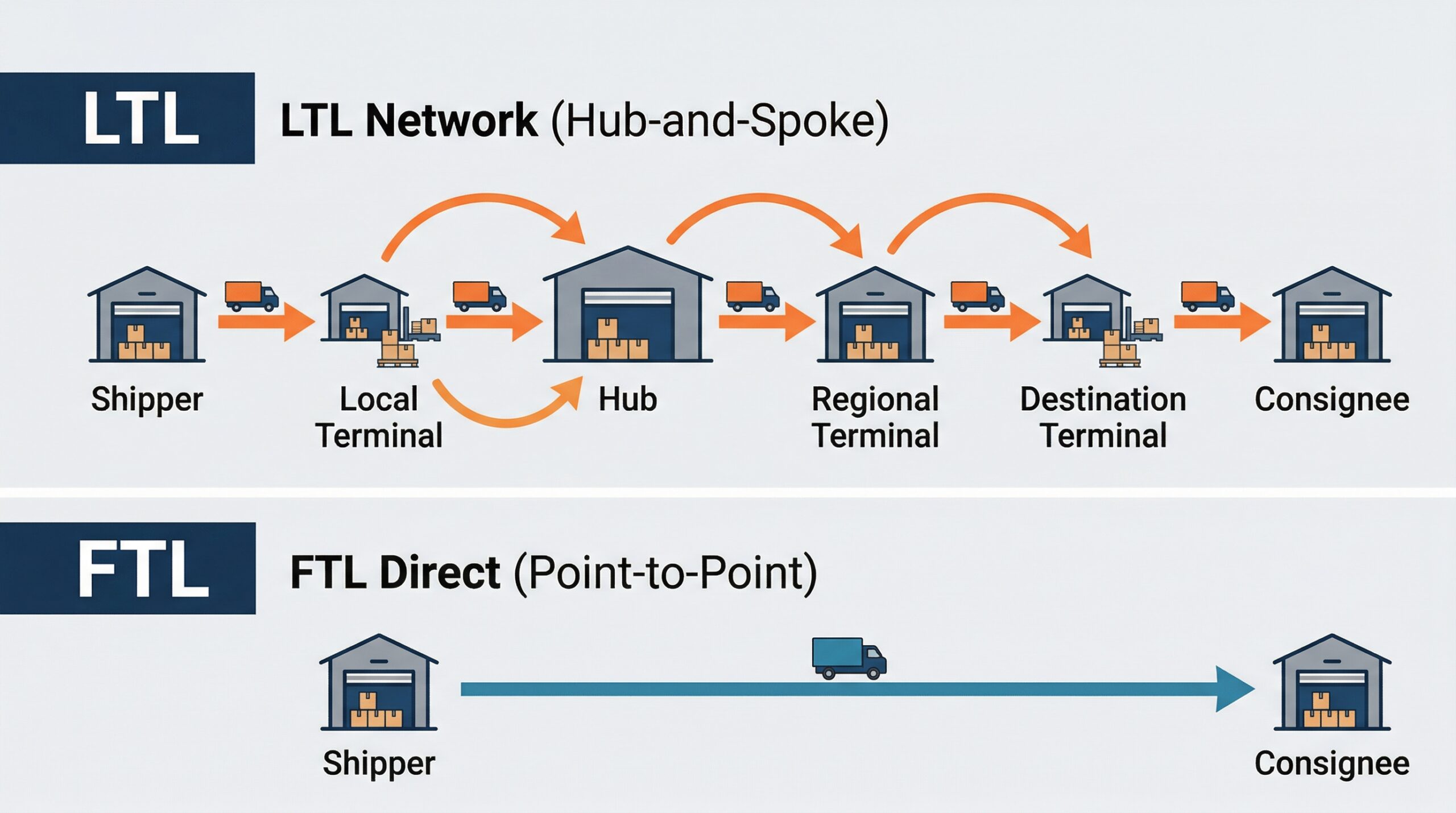
LTL carriers operate on a hub-and-spoke model. Your LTL freight is picked up and taken to a local terminal, consolidated with other shippers’ goods, then moved via linehaul to one or more intermediate terminals before final delivery. A single shipment may pass through five or six facilities, getting loaded and unloaded at each stop (RXO).
FTL Linehaul Flow
FTL shipments travel direct from origin to destination. The trailer is sealed at pickup and opened at delivery—no terminal stops, no rehandling. This point-to-point simplicity is why full truckload shipping consistently delivers faster transit and fewer claims.
Benefits & Considerations (and How to Avoid Common Pitfalls)
Both modes offer real advantages, but each also carries risks that can erode savings if you’re not careful.
LTL benefits: Lower cost for small shipments, no need to fill a trailer, and broad carrier network coverage. LTL pitfalls: Billing adjustments from inaccurate dimensions, transit delays during peak seasons (average LTL on-time delivery was just 82% in 2024, per Flock Freight), and higher damage risk.
FTL benefits: Faster transit, minimal handling, schedule predictability, and simpler pricing. FTL pitfalls: Higher upfront cost (especially if you don’t fill the trailer), rate volatility during peak seasons, and less flexibility for fluctuating volumes.
The industry is also evolving beyond the strict LTL-or-FTL binary. As Chris Pickett, COO of Flock Freight, has observed, the U.S. truckload market has long been locked into a rigid “full or empty” mindset—and shippers benefit from rethinking that approach (Commercial Carrier Journal).
Use Cases: When to Choose LTL vs FTL (Real-World Scenarios)
The best shipping mode depends on what you’re shipping, how much, and how fast it needs to arrive.
Choose LTL When…
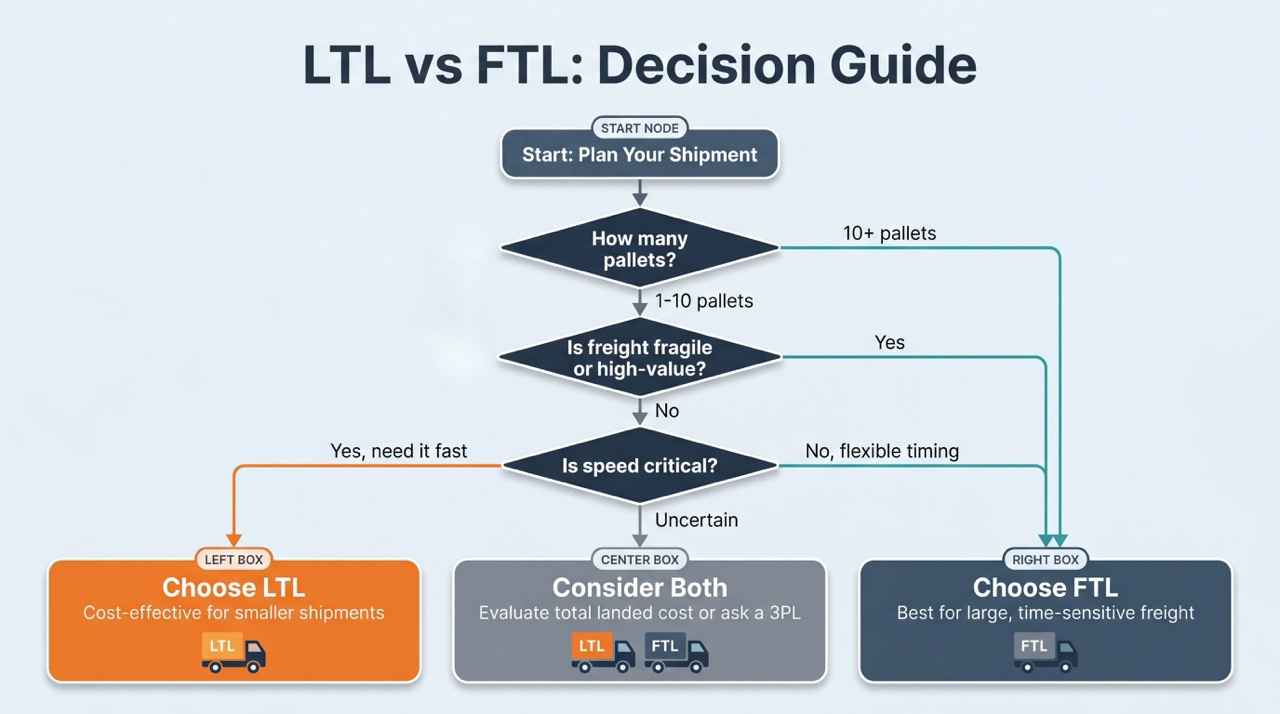
- You ship 1 to 6 pallets (or partial loads) on a regular basis.
- You’re sending smaller quantities to multiple consignees across different regions.
- Your priority is cost efficiency over speed, and you can accommodate 3–7 day transit windows.
- Our LTL service gives you access to a broad carrier network with competitive rates and full shipment visibility.
Choose FTL When…
- You consistently ship near-truckload volumes (10+ pallets or 15,000+ lbs).
- You need faster transit or tighter delivery windows.
- You’re shipping fragile, high-value, or temperature-sensitive freight where fewer touches matter.
- You want fewer claims and a simpler billing experience.
“Gray Area” Scenarios
Not every shipment fits neatly into one category. During surge periods, seasonal spikes, or promotional pushes, volumes can shift weekly. Consider consolidation strategies—combining multiple smaller LTL shipments into a single weekly FTL load. For long-distance lanes where speed matters, FTL almost always wins, even if the trailer isn’t full.
Factors to Consider When Choosing Between LTL and FTL
Selecting the right mode requires evaluating several variables beyond just shipment weight.
- Shipment size, weight, cube, and pallet count — If it fills half a trailer or more, price out FTL.
- Freight characteristics — Fragile, hazmat, or temperature-controlled goods often favor FTL for reduced handling.
- Delivery requirements — Residential, liftgate, or limited-access needs add accessorial costs to LTL and may justify FTL.
- Time sensitivity — Standard timelines work for LTL; expedited or appointment-critical needs favor FTL.
- Risk tolerance — If claims are an ongoing issue, FTL’s minimal handling reduces incidents significantly.
- Budget goals — Evaluate total landed cost (including delays, returns, and claims)—not just the line-haul rate.
Optimizing Freight Shipping Choices
Small operational improvements can yield significant savings across both shipping modes.
- Improve packaging and palletization to reduce damage and reclassification risk.
- Measure accurately — Record dimensions and weight precisely to avoid carrier billing adjustments.
- Consolidate shipments — Use zone-skipping or weekly FTL consolidation to lower per-unit costs.
- Use appointment discipline — Avoid detention and demurrage charges by meeting scheduled windows.
- Build a lane guide and review cost per shipment, on-time percentage, and claims ratio regularly to spot optimization opportunities.
Working With Third-Party Logistics Providers (3PLs)
A 3PL partner can simplify mode selection and optimize your freight spend.
How a 3PL Helps With LTL + FTL
Third-party logistics providers aggregate volume across many clients, giving them leverage to negotiate better carrier rates. A good 3PL provides technology for real-time quoting, tracking, and freight audit. Because carriers rarely share damage statistics publicly, 3PLs use their operational data to identify carriers with strong service and low claims ratios (Olimp Warehousing).
What to Ask a 3PL
- Do you offer both LTL and FTL services with rate comparison tools?
- How do you handle claims management and carrier scorecarding?
- Can you provide consolidated reporting across modes and lanes?
- What technology do you use for visibility and freight audit?
Conclusion
Choosing between LTL and FTL isn’t a one-time decision—it’s an ongoing strategy that adapts as your volumes and needs evolve. LTL shipping gives you cost-efficient flexibility for smaller shipments, while full truckload shipping delivers speed, security, and simplicity for larger loads. The key is evaluating total landed cost, not just the rate on the invoice.
At Alpha Zero Logistics, we build freight strategies that balance cost, speed, and reliability. Whether you need help optimizing your LTL shipments, securing competitive truckload rates, or developing a comprehensive transportation plan, our team is ready. Talk to one of our logistics experts today to find the right freight solution for your business.
────────────────────────────────────────
Sources
Commercial Carrier Journal. (2024). Study highlights costs of underutilized truckload space and inefficiencies in LTL shipping. https://www.ccjdigital.com/economic-trends/article/15676310/study-highlights-costs-of-underutilized-truckload-space-and-inefficiencies-in-ltl-shipping
C.H. Robinson. (2025). North America LTL freight market update. https://www.chrobinson.com/en-us/resources/insights-and-advisories/north-america-freight-insights/jan-2025-freight-market-update/key-freight-service-updates/na-ltl/
Flock Freight. (n.d.). The hidden costs of less than truckload shipping. https://www.flockfreight.com/blog/the-hidden-costs-of-less-than-truckload-shipping
Fortune Carriers. (2025). LTL vs FTL: What’s the difference in freight shipping. https://fortunecarriers.net/ltl-vs-ftl-shipping-key-differences-every-business-should-know/
Olimp Warehousing. (2025). Low-damage LTL carrier selection & freight damage prevention. https://olimpwarehousing.com/ltl-carrier-low-damage-shipping/
RXO. (2025). Crush LTL freight claims like a pro with these 8 lessons. https://rxo.com/resources/shipper/ltl-freight-damage-claims/
The Supply Chain Xchange. (2024). NMFTA looks to simplify freight classification rules in 2025. https://www.thescxchange.com/move/nmfc-changes-2025