
Choosing a freight broker on price alone is costly; the cheapest quote often hides the highest total cost. At Alpha Zero Logistics, we’ve found that knowing how to choose a freight broker comes down to asking sharper questions. Here are nine.
TL;DR: A great freight broker is a strategic partner, not a commodity priced at the lowest rate. Before signing, pressure-test any broker on nine fronts: licensing, carrier vetting, contract clarity, financial health, honest limits, freight procedures, exception handling, tech resilience, and capacity flexibility. The answers separate reliable from costly.
Introduction: The Danger Zone of Choosing the Wrong Partner
A freight broker is a connector, not a carrier: a licensed intermediary that arranges transportation between you and vetted trucking companies. That distinction carries real legal weight.
The most common confusion is broker versus freight forwarder. A broker arranges transportation but never takes possession of your freight, while a forwarder consolidates, stores, and takes custody, often internationally. That difference shapes who holds liability and who files a claim.
Know What You Need From a Freight Broker First
Before comparing brokers, define what success actually looks like for your freight.
Consider your typical shipment volume and frequency, primary lanes, equipment requirements, freight type, delivery expectations, seasonal fluctuations, visibility needs, and budget priorities.
A broker can be reputable and still be the wrong fit if they lack experience with your freight type, geographic coverage, equipment requirements, or service expectations.
Knowing your non-negotiables upfront also makes the nine questions below far more useful.
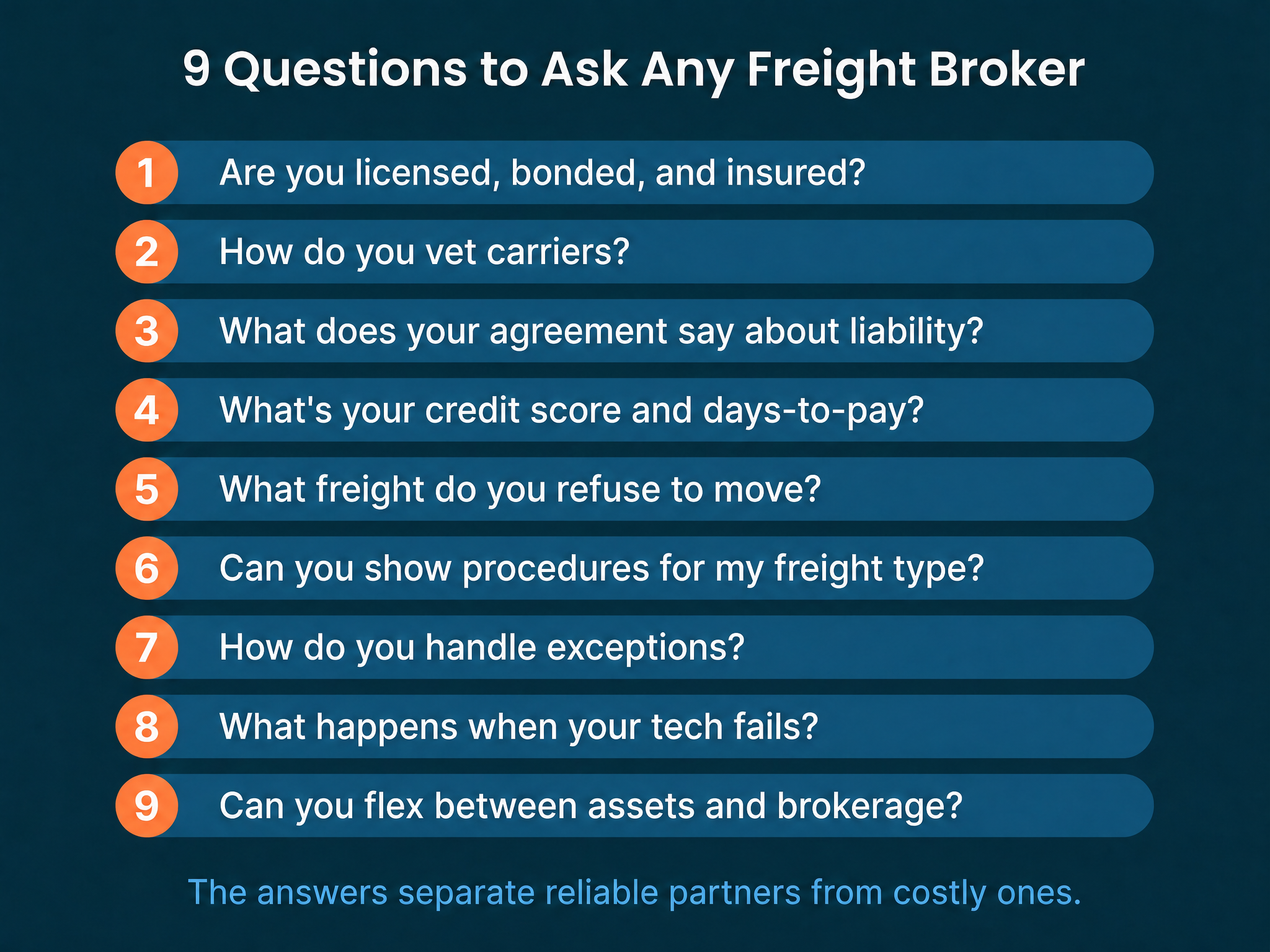
Q1: Are You Properly Licensed, Bonded, and Backed by Contingent Cargo Insurance?
Licensing and financial security are the floor, not a feature. A broker must hold active FMCSA authority and maintain $75,000 in financial security through either a BMC-84 surety bond or BMC-85 trust fund. Contingent cargo coverage can provide an additional layer of protection, although it is not federally required for standard property brokers. Missing required paperwork is an immediate disqualifier.
Confirm the broker holds valid authority from the Federal Motor Carrier Safety Administration (FMCSA), backed by the required $75,000 in financial security. A BMC-84 surety bond, for example, can help protect carriers if the broker fails to meet its payment obligations. Then ask whether the broker carries contingent cargo insurance, which may act as a safety net when a carrier’s primary policy fails, lapses, or denies a claim.
A federal enforcement sweep targeted brokers with “recent and repeated lapses in either insurance and bonding,” said FMCSA enforcement director Tom Liberatore. A broker who cannot verify its active authority and required financial security is an immediate red flag. Contingent cargo insurance can provide additional protection, but its absence alone does not mean a broker is operating illegally.
Q2: How Do You Vet Carriers and Prevent Double Brokering?
Network quality beats network size. What matters is how rigorously each carrier is vetted, and how the broker prevents double brokering.
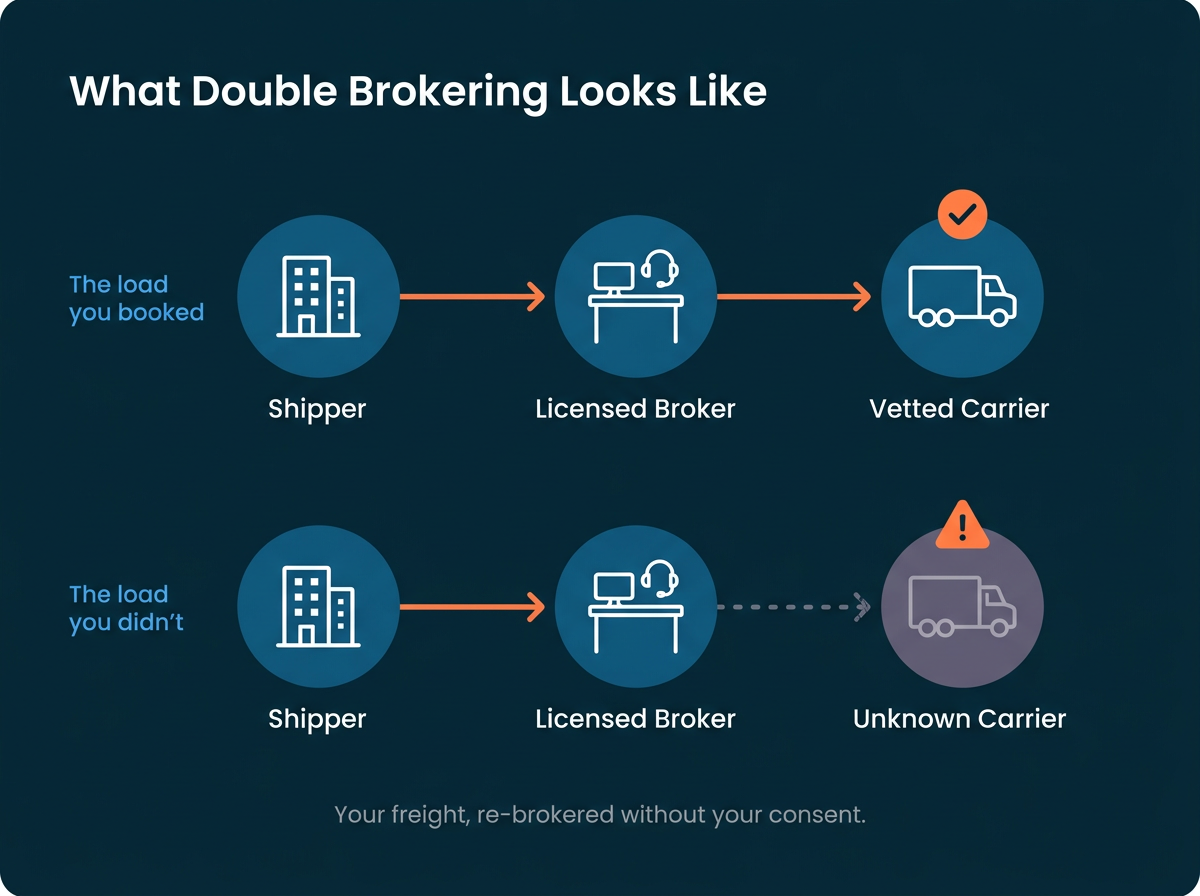
Ignore the “15,000 carriers” boast and ask how many moved freight in the last 30 days. Before placing a load, we apply a firm vetting standard:
- At least one year in business
- Verified FMCSA safety records
- A minimum of three DOT inspections
Double brokering, where a carrier secretly re-brokers your load to an unknown third party, is what that vetting stops, and unlawful brokerage is the most commonly reported fraud scheme in freight. TIA President and CEO Chris Burroughs calls it “no longer an inconvenience—it’s a crisis.”
Q3: What Does the Broker Agreement Say About Roles and Responsibilities?
Read the contract as risk management, not paperwork. Vague terms around liability, claims, and payment create real financial exposure.
Focus on the three areas where ambiguity costs most: the liability split (who pays for damaged cargo, and up to what limit), the claims process (procedure, timeline, ownership), and payment terms (how and when they pay carriers). A well-run broker is specific on all three; vagueness is a red flag.
Q4: What is Your Brokerage Credit Score and Average Days-to-Pay?
Credit score and days-to-pay are objective trust signals. They reveal how carriers, the people who move your freight, perceive the broker’s reliability.
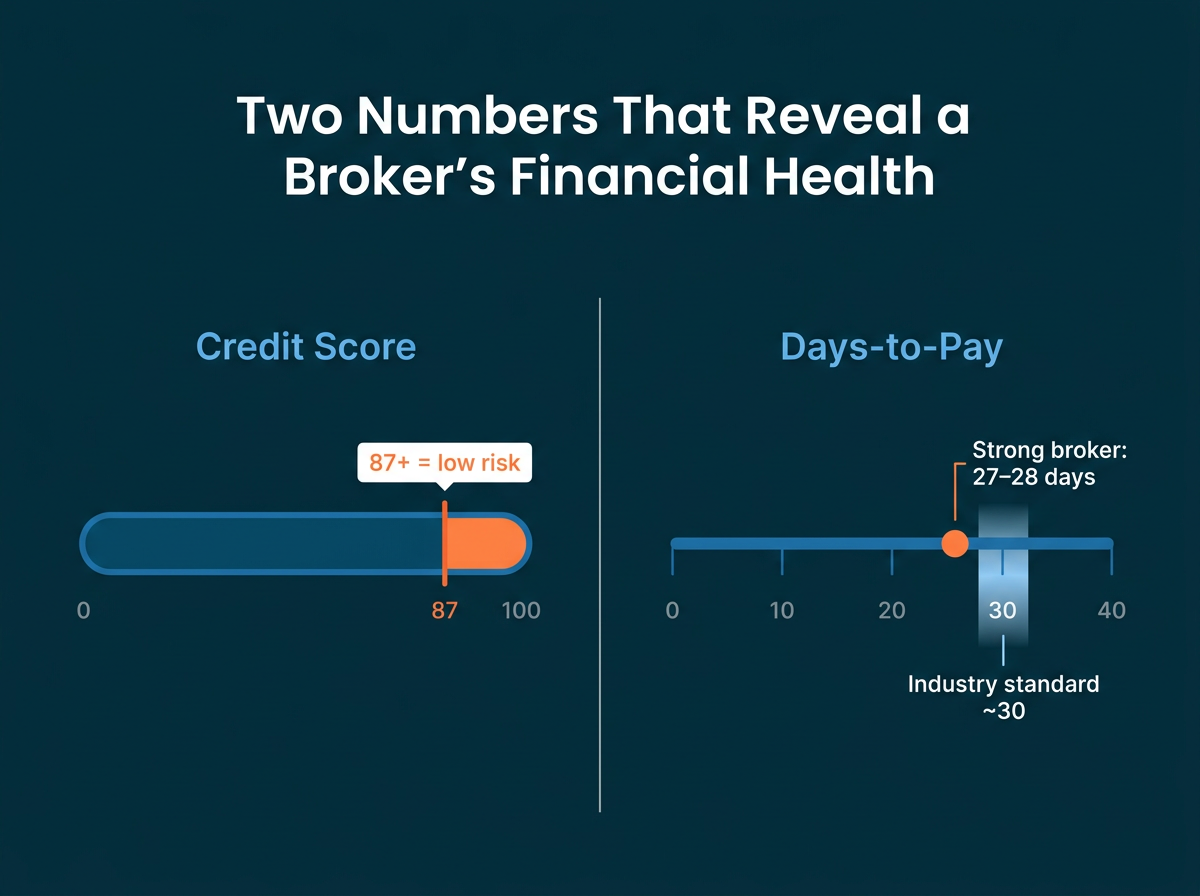
Ask for two numbers carriers already see. First, the credit score: bureaus like Ansonia use a 0-100 scale, where 87 or above signals low risk. Second, average days-to-pay, how long the broker takes to pay carriers. With standard terms around 30 days, a broker paying in about 27 to 28 days is one carriers trust and prioritize, which keeps your freight moving.
Q5: What Freight Do You Refuse to Move?
Defined limits signal discipline, not weakness. A broker who admits what they won’t handle is showing you operational honesty.
A confident “we don’t move that” tells you more than “we can move anything.” Brokers who claim no limits are overselling. The mature answer names real constraints: lanes, commodities, or volumes they can’t reliably handle. When we decline a load, we’re protecting the relationship, not overpromising.
Q6: Can You Share Your Established Procedures for Handling My Specific Freight Type?
Ask for documented procedures, not reassurances. Specificity is the real test of whether a broker understands your freight.
“We handle that all the time” is not an answer; a written process is. For specialized freight, ask how they source equipment and handle problems. A dry-van-to-reefer shift is a good test: can they explain how they secure units, monitor temperature, and cover failures?
Q7: How Do You Handle Exceptions and Treat Your Smallest Active Customer?
Character shows in exceptions, not normal operations. How a broker handles disruptions, and its smallest accounts, predicts how it will handle yours.
Ask about a recent exception — a breakdown, a rejected delivery, a closed lane — and how they resolved it. Then ask how they treat their smallest active customer; that predicts how your account is handled once you’re no longer the new win. Brokers who treat small accounts like large ones deliver under pressure. Then check the outside signal: ask current shippers for references and read reviews, since a broker’s reputation and client feedback reveal what a pitch won’t.
Q8: How Do You Balance Automation, and What Happens When Your Tech Fails?
The real test isn’t the technology, it’s the backup. A resilient broker pairs automation with human oversight and clear protocols for outages.
Technology should make a broker faster and clearer, but it can’t be all that holds freight together. Ask what happens when the tracking feed drops. A strong answer has three backup layers: redundant tracking, clear communication, and manual escalation when automation fails. The best operators treat tools as extensions of skilled people, the principle behind our Managed Transportation Services.
Q9: Can You Seamlessly Flex Between Dedicated Assets and Brokerage Capacity?
A hybrid model is a reliability signal, not a service menu. Brokers who shift between owned assets and brokered capacity hold up best when the market tightens.
Flexibility matters most when it’s hardest to find. Ask whether a broker can flex between dedicated assets and brokered capacity, so freight stays covered during a crunch or spike. A one-track broker has fewer options when the market turns. Operators who run their own assets grasp carrier-side realities, sharpening how they broker.
Where Most Shippers Get This Wrong
Most shippers lead with rate, and it costs them over time. A low quote hides higher total costs once service gaps and rework are counted.
A shipper picks the lowest bid, then absorbs hidden costs for months: missed pickups that stall production, poor communication that forces follow-up, and reactive problem-solving that turns every exception into a fire drill. A cheaper rate per load often costs far more in overtime, expedites, and lost trust.
A Simple Way to Compare Brokers Side by Side
Turn the nine questions into a scoring rubric. A structured, side-by-side comparison replaces vague marketing claims with measurable metrics you can weigh.
Instead of comparing sales pitches, score each broker on the same verifiable factors, such as credit score, active carrier utilization, and documented exception handling. Use the table below; the right partner becomes obvious.
Evaluation Criterion | What to Ask For | Strong Signal |
Credit & payment | Credit score and days-to-pay | 87+ score; pays within 30 days |
Carrier network | Carriers used in the last 30 days | Vetted, verifiable, actively used |
Exception handling | A recent real-world example | Specific, fast, human-led resolution |
Technology resilience | The backup when systems fail | Redundant tracking plus manual escalation |
Capacity flexibility | Asset vs. brokered options | Can flex between both |
Reputation & feedback | Client references and reviews | Verifiable references; consistent reviews |
The Difference Shows Up in Execution
The goal isn't a perfect freight broker, it's the right operational fit. A true partner proves itself on the difficult shipments, not the easy ones.
You're not after a flawless broker, but the right match for your freight and lanes. Any broker handles a routine load; the real test comes when a shipment goes sideways, and the right partner is built to hold up then. We wrote this because the right fit turns shipping from a headache into a non-event.
One last piece of advice from our side of the table: how a broker answers matters as much as what they answer. Listen for specificity — documents offered, numbers named, a recent example given without hesitation. A broker who answers eight questions openly and admits a limit on the ninth will beat one who claims perfection on all nine. If you're weighing options, explore our Freight Brokerage Services to see how we work.
Sources
Federal Motor Carrier Safety Administration. (2026). Broker and freight forwarder financial responsibility rule overview and compliance requirements. U.S. Department of Transportation. https://www.fmcsa.dot.gov/registration/broker-and-freight-forwarder-financial-responsibility-rule-overview-and-compliance
Falvey Insurance Group. (2025). What is contingent cargo liability risk? https://falveyinsurancegroup.com/blog/transportation-logistics/what-is-contingent-cargo-insurance/
Transportation Intermediaries Association. (2025). TIA releases State of Fraud in the Industry April 2025 report. https://news.tianet.org/tia-releases-state-of-fraud-in-the-industry-april-2025-report/
Dills, T. (2024). FMCSA’s first-ever blitz of its kind aims at scofflaw brokers. Overdrive. https://www.overdriveonline.com/regulations/article/15708013/fmcsas-firstever-blitz-of-its-kind-aims-at-scofflaw-brokers
DAT Freight & Analytics. (2022). 5 simple ways brokers can improve their credit score. https://www.dat.com/blog/5-simple-ways-brokers-can-improve-their-credit-score
DAT One. (n.d.). Credit score – Ansonia FAQs. https://one.support.dat.com/9-resources-52e74931/credit-score-ansonia-faqs-a60b3742