
TL;DR: Freight collect vs prepaid comes down to one question — who pays the carrier. With freight prepaid, the shipper pays; with freight collect, the consignee (receiver) pays. The right choice depends on carrier relationships, cash flow, and your contract terms. Below, we cover the definitions of freight collect and freight prepaid, their key differences, and how to choose.
Every freight shipment answers one question before pickup: who pays the transportation charges? Freight collect and freight prepaid are the terms that settle it, and getting them right shapes your shipping costs, operational efficiency, and business relationships. At Alpha Zero Logistics, we manage these payment terms daily, and we've seen how a mislabeled bill of lading triggers billing disputes and delays.
The stakes add up fast. Every day, the U.S. transportation system moves about 53.6 million tons of freight worth more than $54 billion, according to the Bureau of Transportation Statistics — and every shipment's payment term decides who foots the bill. Our Freight Brokerage Services help shippers get these terms right.
What Is Freight Collect?
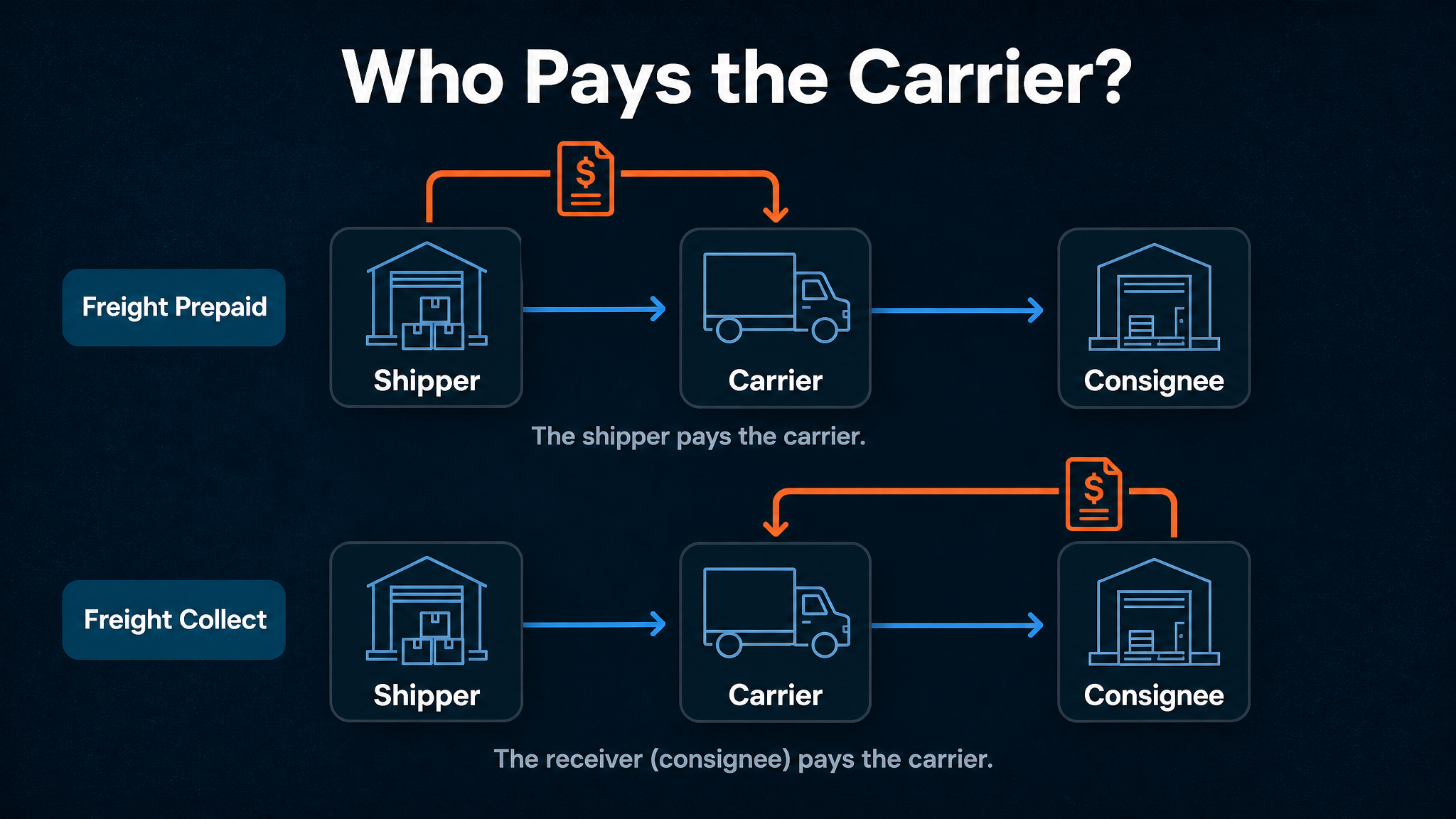
Freight collect is a payment arrangement in which the consignee (the receiver) is responsible for the freight charges. The shipper arranges the shipment, but the carrier bills the receiver.
Under freight collect, the receiver pays the transportation charges upon delivery or per the carrier's billing terms. The shipper prepares and tenders it but does not pay the carrier's invoice. This is common when buyers manage their own carrier relationships and want control over shipping costs; retailers often route inbound freight this way. Freight collect defines who pays, not who owns the goods.
What Is Freight Prepaid?
Freight prepaid is a payment arrangement in which the shipper pays the transportation charges, typically before delivery. The carrier bills the shipper, not the receiver.
With freight prepaid, the shipper pays the freight charges directly to the carrier. Those costs may be absorbed or built into the product price. Prepaid simplifies purchasing and delivery — the buyer receives goods without arranging payment on arrival. Sellers often prefer it to control scheduling and service levels. Like collect, it settles who pays, not who owns the goods.
Freight Collect vs. Prepaid: What's the Difference?
The key differences between freight collect and prepaid are who pays, who controls the shipment, and when the money moves. Collect assigns costs to the consignee; prepaid assigns them to the shipper.
The difference shows up in three places. Billing responsibility: collect bills the receiver, prepaid bills the shipper. Payment timing: collect invoices the receiver at or after delivery, while prepaid bills the shipper around shipment. Control: the paying party usually selects the carrier and sets routing, affecting visibility and accountability. Cash flow and admin workload shift too. The table summarizes the key differences between freight collect and prepaid.
| Factor | Freight Collect | Freight Prepaid |
| Who pays the carrier | Consignee (receiver) | Shipper (sender) |
| Who is billed | Receiver's freight account | Shipper's freight account |
| Typical carrier selection | Usually the buyer/receiver | Usually the shipper/seller |
| Cost control sits with | Receiver | Shipper |
| Cash flow impact | Receiver funds freight at/after delivery | Shipper funds freight upfront |
| Common use case | Buyers with negotiated carrier rates | Sellers simplifying the delivery |
Who Pays for Freight and What Are Their Responsibilities?
The shipper prepares and tenders the shipment, while the consignee receives it and may owe the freight charges. Clear documentation keeps these roles and responsibilities in freight payment from turning into disputes.
The roles and responsibilities in freight payment start with two parties. Shippers (consignors) coordinate shipment preparation, packaging, and transportation. Consignees receive the shipment and, under collect terms, owe the freight charges. A broker or 4PL may also be designated to pay — third-party billing.
Documentation requirements center on the bill of lading (BOL). Federal regulations require a motor carrier's BOL to identify the parties, origin, destination, and freight, under 49 CFR 373.101. It's also where “prepaid” or “collect” is marked — a wrong entry can misroute the invoice. Freight invoices and purchase orders complete the trail, and because carrier bills often contain errors, many shippers use Freight Audit and Payment Services to verify charges before paying.
When Freight Collect Makes Sense (And When It Doesn't)
Freight collect makes the most sense when the receiver has strong carrier relationships and wants control over costs. It works less well when billing coordination breaks down.
Freight collect is most effective for buyers who actively manage transportation.
Where freight collect helps:
- Cost control for the receiver — the buyer applies its own negotiated rates instead of the shipper's pricing.
- No upfront cost for the shipper — sellers avoid paying carriers and the related overhead.
Where it creates friction:
- Billing disputes and delays — a slow-paying consignee or wrong BOL account details can hold up goods or misroute the invoice.
- A poor fit for one-off shipments — customers with no carrier program of their own gain little.
When Freight Prepaid Makes Sense (And When It Doesn't)
Freight prepaid makes the most sense when the shipper wants control over the shipment and a simpler experience for the customer. The trade-off is carrying the freight cost upfront.
Freight prepaid shines when a simple delivery experience matters.
Where freight prepaid helps:
- Simpler for the receiver — goods arrive without the buyer arranging payment, which helps build trust or serve buyers without their own logistics infrastructure.
- Control for the shipper — the seller chooses carriers and service levels that fit its delivery promises.
Where it creates friction:
- Upfront cost — the shipper funds freight first, straining cash flow and margins unless recovered through pricing or a “prepaid and add” arrangement.
- Weaker when the buyer holds better rates — prepaid makes less sense if the receiver has stronger carrier pricing.
How to Choose Between Freight Collect and Prepaid
Choosing the right freight payment method is a business decision, not a default. Weigh who has the better carrier rates, how each option affects cash flow, and what experience you want customers to have.
When we help shippers decide, we weigh the pros and cons of each method against three questions:
- Who holds stronger carrier rates? That party is usually the one to pay and route the freight.
- Does prepaid's upfront cost strain cash flow? If freight would tie up working capital the business needs elsewhere, collect may fit better.
- What do customers expect? Convenience-focused businesses often lean prepaid, while those running mature transportation programs may prefer collect.
Volume, carrier relationships, and cash flow ultimately tip the decision. The stakes are rising, too: logistics costs are “going to be a little bit more prominent and pronounced” in companies' profit and loss statements, says Korhan Acar, a Kearney partner and lead author of the CSCMP State of Logistics Report.

Related Freight Terms You Should Know
Freight collect and prepaid are often confused with related shipping and billing terms like “prepaid and add” and FOB. Knowing the difference keeps your contracts clear.
Two related terms come up most often, and confusing them with freight collect and prepaid is common.
Freight Prepaid and Add
Freight prepaid and add is an arrangement where the shipper pays the carrier upfront, then bills the customer for the freight as a separate line item rather than burying it in the product price. This keeps freight charges visible and combines prepaid freight with direct cost recovery — useful when the shipper holds better carrier rates than the buyer.
FOB Origin vs. FOB Destination
FOB (Free on Board) terms determine when ownership and risk transfer between buyer and seller — a different question from who pays the freight. Under the Uniform Commercial Code, FOB Origin (shipping point) gives the buyer title and risk at pickup; FOB Destination leaves them with the seller until arrival.
At the FOB point, “legal title and risk of loss passes from seller to buyer,” notes Cornell Law School's Legal Information Institute in its summary of UCC § 2-319.
FOB governs risk and title; freight terms govern payment. Either freight collect or prepaid can be paired with FOB Origin or FOB Destination, depending on the contract.
Tip: On international moves, align the freight term with the Incoterm. Under CIF or CFR the seller pays the freight to the destination port, so the bill of lading should read “freight prepaid.”
Putting It Together
Freight collect places transportation costs on the consignee; freight prepaid places them on the shipper. Each has clear advantages, and the best choice depends on your goals, carrier relationships, and customer expectations.
Freight collect vs. prepaid is a decision about who pays, who controls the shipment, and how that shapes cost and service. Collect puts costs and control with the consignee, which suits organizations that manage their own carrier programs. Prepaid keeps control with the shipper and simplifies the buyer's experience, at the cost of carrying freight expense upfront. Many shippers use both.

We wrote this guide because we see the same avoidable problems — mismarked BOLs, surprise invoices, strained relationships — whenever these terms are misunderstood. Getting them right protects margins and keeps freight moving. If you'd like help structuring freight payment terms across your network, our Managed Transportation Services team can help.
Common Questions About Freight Collect and Prepaid
These are the frequently asked questions and common confusions we hear most often about how freight collect and prepaid work.
Who Pays for Freight Collect Shipments?
The consignee — the receiver — pays for freight collect shipments. The carrier bills the receiver for transportation charges at or after delivery, per the agreed terms. The shipper arranges the shipment but does not pay the freight invoice.
Is Freight Prepaid the Same as Free Shipping?
No. Freight prepaid means the shipper pays the carrier, though that cost is often built into the product price or billed back separately. Free shipping means the buyer pays nothing because the seller absorbs the cost. Prepaid describes who pays the carrier; free shipping describes what the customer is charged.
Is CIF Freight Collect or Prepaid?
CIF (Cost, Insurance, and Freight) is effectively freight prepaid. Under this Incoterms 2020 rule, the seller pays the freight to the destination port, so the bill of lading typically shows “freight prepaid.” CIF also requires the seller to insure the goods in transit.
Is CFR Freight Collect or Prepaid?
CFR (Cost and Freight) is also freight prepaid. Like CIF, the seller pays the freight to the destination port; the difference is that CFR doesn't require the seller to insure the goods for the buyer. Both terms apply only to ocean and inland waterway shipments.
Sources
Bureau of Transportation Statistics. Moving Goods in the United States. https://data.bts.gov/stories/s/Moving-Goods-in-the-United-States/bcyt-rqmu/
Electronic Code of Federal Regulations. 49 CFR § 373.101 — For-hire, non-exempt motor carrier bills of lading. https://www.ecfr.gov/current/title-49/subtitle-B/chapter-III/subchapter-B/part-373/subpart-A/section-373.101
International Chamber of Commerce (ICC Academy). Incoterms 2020: CFR or CIF?. https://academy.iccwbo.org/incoterms/article/incoterms-2020-cfr-or-cif/
International Trade Administration (trade.gov). Know Your Incoterms. https://www.trade.gov/know-your-incoterms
Legal Information Institute, Cornell Law School. Uniform Commercial Code § 2-319: F.O.B. and F.A.S. Terms. https://www.law.cornell.edu/ucc/2/2-319
The Supply Chain Xchange. State of Logistics Report: Highlighting Uncertainty in Supply Chain. https://www.thescxchange.com/move/state-of-logistics-report-2025