

TL;DR To choose a managed transportation provider, evaluate candidates across six factors: service scope, technology and TMS capability, supply chain visibility, dedicated expertise and support, industry fit, and pricing transparency — not just price. At Alpha Zero Logistics, we’ve seen buyers succeed when they treat provider selection as a long-term partnership decision rather than a transactional bid, prioritizing fit, scalability, and operational support over the cheapest quote. |
Freight costs are rising, customer expectations are tightening, and the carrier and mode mix you ran five years ago may no longer fit. At Alpha Zero Logistics, we work with shippers stretched thin trying to manage it all in-house, and we’ve watched the right managed transportation provider turn a reactive operation into a measurable program. This guide covers what these providers do, when one makes sense, and how to evaluate the right fit.
What Is a Managed Transportation Provider?
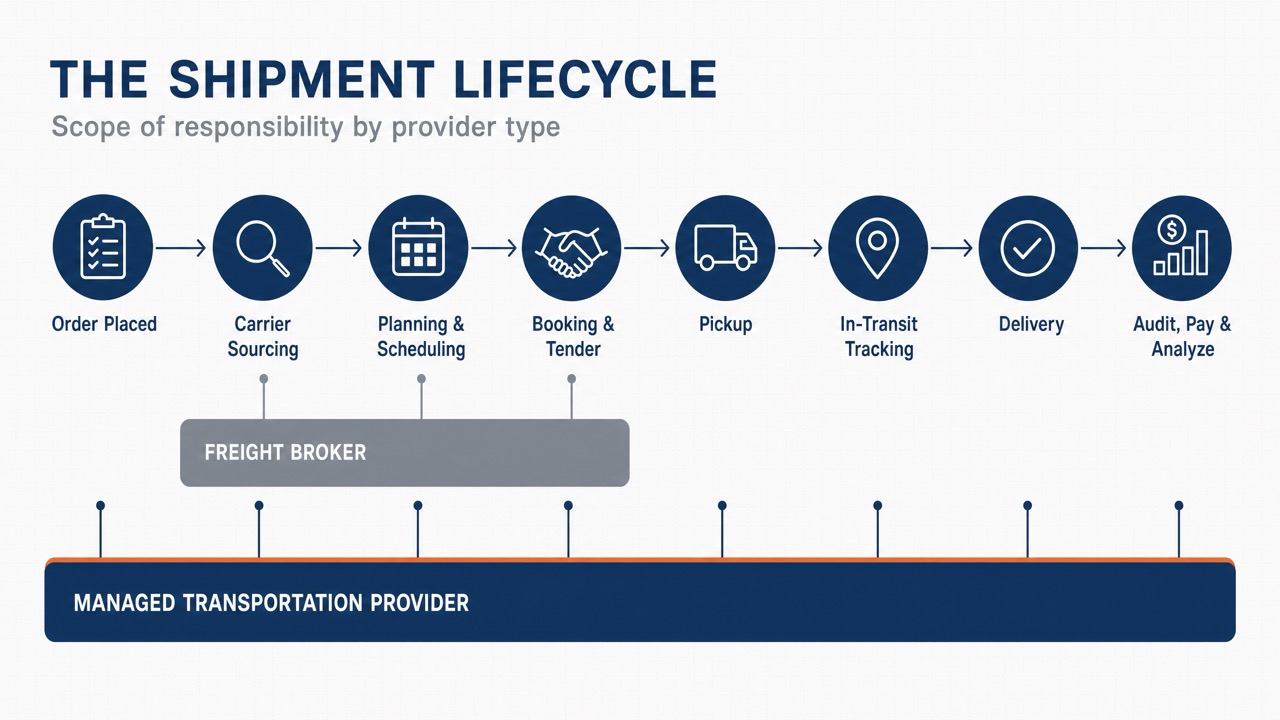
A managed transportation provider owns your day-to-day freight execution and program-level strategy, combining people, processes, and technology.
A managed transportation provider handles transportation management solutions on an ongoing basis, not load by load. They own carrier selection, shipment planning and execution, tracking, freight bill audit and pay, and reporting. Unlike freight brokers, they take program-level accountability for cost, service, and data — and for compliant shipments and KPI performance.
When Should a Company Consider a Managed Transportation Provider?
Consider one when freight complexity outpaces your team, costs are climbing, or shipment visibility is unreliable.
Common signs:
- Rising freight costs with few negotiation levers left
- Lack of visibility into shipments and exceptions
- Inconsistent carrier performance and a routing guide no one trusts
- Internal bandwidth issues from firefighting instead of planning
- Network complexity from new lanes, modes, or facilities
- Service failures at the customer originating in transportation
- Growth-related strain during expansion, M&A, or seasonal peaks
If two apply, expect improved decision-making and a resilient network strategy — including specialized needs like secure, high-touch logistics or temperature-controlled logistics.
What Services Should a Managed Transportation Provider Offer?
A strong provider covers everything from carrier procurement to analytics under one accountable partner.
Expect at minimum:
- Freight carrier procurement and management
- Shipment planning and execution
- Routing and multi-mode optimization
- Tracking, tracing, and exception management
- Freight bill payment and audit
- Compliance audits and a defined carrier qualification process
- Vendor inbound freight management
- Advanced reporting and analytics, including carrier performance scorecards
- Bid process management
If a provider handles only a sliver of this list, they’re closer to a broker. Our Managed Transportation Services cover the full scope so accountability sits in one place.
How Managed Transportation Providers Help Reduce Cost and Improve Efficiency
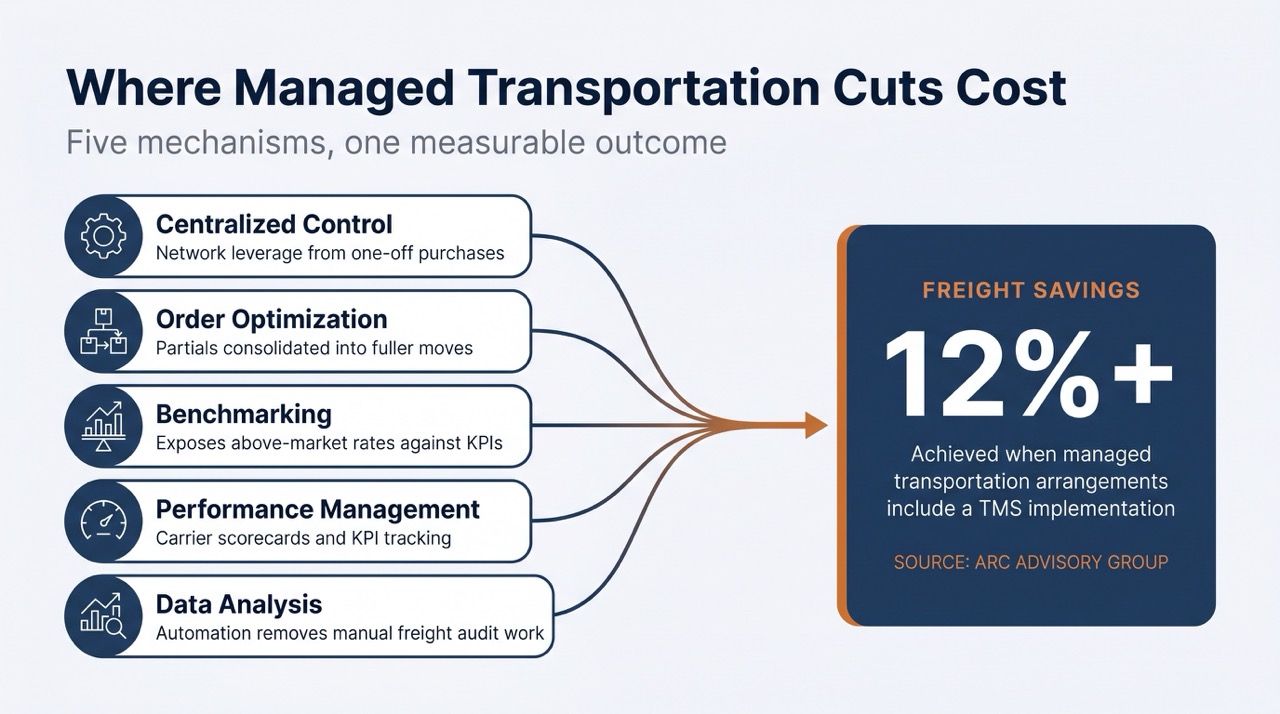
The right provider uses data, consolidation, and centralized control to take cost out of your freight spend.
A strong provider reduces freight costs in several ways. Centralized control over your carrier network turns one-off purchases into leverage. Order optimization and consolidation merge partials into fuller moves. Benchmarking against transportation KPIs plus performance management exposes where you’re paying above market, while automation and data analysis remove manual work like freight audit. According to ARC Advisory Group, managed transportation arrangements delivering freight savings above 12% almost always included a TMS implementation — a hallmark of strategic managed transportation planning.
What Technology and Visibility Should Buyers Expect?
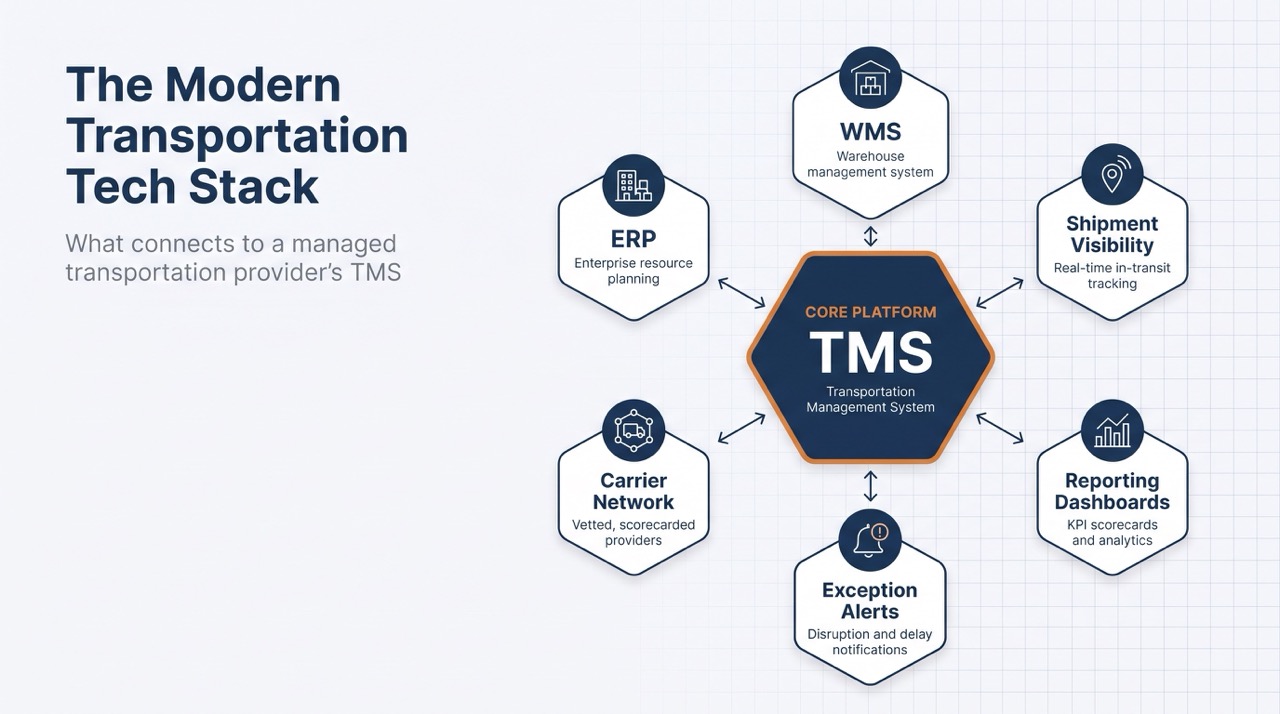
Modern managed transportation runs on a TMS plus the integrations and dashboards that make freight data usable.
Expect a transportation management system (TMS) with shipment visibility tools, reporting dashboards, exception alerts, centralized planning tools, and seamless integrations to your ERP and WMS. The TMS market is projected to grow from $22.35 billion in 2026 to over $82 billion by 2034, according to Fortune Business Insights, as shippers rely on real-time supply chain analytics and in-transit tracking and reporting. Ask whether your data is portable and how their logistics technology turns data insights into action.
Why Expertise and Support Structure Matter
Software alone doesn’t run a freight program. Look for a dedicated account team, proven logistics expertise, and consulting beyond ticket handling.
The biggest predictor of success is the people behind the platform. Dedicated account teams mean a logistics expert knows your network from day one. Personalized support, custom reports, and quarterly consulting reviews — plus a trusted freight carrier network — make this a strategic partnership. Gartner Supply Chain VP analyst David Gonzalez told Food Logistics that logistics leaders face “challenges that they can only address in collaboration with their 3PL partners.” Ask whether you’ll have named contacts and proactive recommendations.
Industry Fit and Customization Questions to Consider
A provider that fits one industry may not fit another. Dig into their experience with your freight profile and modes.
Industry experience matters: specialized freight has specialized rules. Dry van/FTL trucking differs from heavy haul/over-dimensional moves, temperature-controlled logistics, or compliant shipments for pharmaceuticals. Look for tailored solutions, scalable designs, flexible workflows, customizable reports, customized shipment planning, and carrier rating and routing.
How to Evaluate a Managed Transportation Provider
Build a scoring framework around service scope, network quality, technology, support, industry fit, and pricing transparency.
Weight factors deliberately, not by demo quality:
| Factor | What to look for |
|---|---|
| Service scope | Full lifecycle coverage, not point services |
| Carrier network quality | Vetted, scorecarded, financially stable carriers |
| Compliance processes | Documented qualification and audit programs |
| Reporting and analytics | KPI scorecards and business intelligence reporting |
| Technology stack | Modern TMS with integration capabilities |
| Support structure | Dedicated account team and clear escalation paths |
| Strategic consulting | Regular network reviews and supply chain engineering input |
| Industry fit | Experience with your freight profile and modes |
| Scalability | Ability to absorb seasonal peaks and growth |
| Pricing transparency | Clear management fee, pass-through carrier costs |
Score each provider against these factors using your own weights. Research from Armstrong & Associates, covered by Logistics Management, shows 94% of domestic Fortune 500 companies now work with at least one 3PL — combine KPI scorecards, business intelligence reporting, supply chain visibility, and supply chain engineering into one accountable program.
Questions to Ask Before Choosing a Provider
The right questions force specifics — services, technology, integrations, KPIs, team, and savings.
Ask any shortlisted provider:
- What services are included — and what’s an add-on?
- How do you qualify and continuously monitor carriers?
- What TMS do you use, and is our data portable?
- What ERP, WMS, and order management systems do you integrate with?
- What KPIs do you report on, and how often?
- How do you manage exceptions, and what’s the escalation path?
- What industries do you serve, and what freight profiles do you have the most experience with?
- Will we have a dedicated team — and who exactly?
- How do you identify ongoing cost-savings opportunities?
- How do you support our network as it changes over time?
Red Flags to Watch For
Vague scopes, weak reporting, and generic approaches signal a provider isn’t built for program-level accountability.
Warning signs include:
- Vague service scope that shifts to fee add-ons after signing
- Limited reporting with no real performance benchmarking
- Weak visibility tools that only show shipments after they’ve moved
- No clear carrier qualification process — they’ll use whoever bids lowest
- Unclear support model with rotating contacts and slow responses
- Poor integration capabilities that force manual workarounds
- Generic, non-customized approaches that ignore your freight profile
- Unclear performance measurement — no defined KPIs or scorecards
If you see two or more in a sales conversation, expect more after signing.
Final Thoughts: Choosing the Right Managed Transportation Provider
Choose based on fit and long-term value, not price alone. The right provider blends service, technology, visibility, and expertise into a scalable partnership.
The right provider is the one whose fit, technology, expertise, and operational support match where your business is headed. The cheapest bid often costs the most. We wrote this because we’ve watched too many shippers pick on price and pay for it later. To talk with our logistics experts, reach out to our team.
FAQs
Q1: How long does it take to transition to a managed transportation provider?
Most transitions take 60 to 120 days, depending on network complexity and data readiness. Well-prepared shippers go live in under 90 days.
Q2: Can a managed transportation provider work with my existing carriers?
Yes. A strong provider folds incumbent carriers into a unified routing guide and layers in additional capacity where it improves cost or service.
Q3: Do managed transportation providers support seasonal shipping fluctuations?
Yes. Access to flex capacity through a vetted carrier network lets you scale during peaks without overcommitting in slower periods.
Q4: Can managed transportation services scale with business growth?
They should. Look for scalable designs, modular technology, and a model that absorbs new lanes, modes, or facilities without renegotiation.
Q5: What internal team members should be involved in provider selection?
Include supply chain leadership, transportation operations, IT, finance, and procurement. Cross-functional input prevents blind spots.
Q6: How often should a managed transportation provider review performance?
At minimum, monthly operational reviews and quarterly strategic business reviews.
Sources
- ARC Advisory Group. (n.d.). Managed transportation ROI keeps on truckin’. https://www.arcweb.com/industry-best-practices/managed-transportation-roi-keeps-truckin
- Berman, J. (2026). Shippers expand 3PL use amid tech gains and market shifts, notes new Armstrong & Associates report. Logistics Management. https://www.logisticsmgmt.com/article/shippers_expand_3pl_use_amid_tech_gains_and_market_shifts_notes_new_armstrong_associates_report
- Food Logistics. (2021). Gartner Inc.: 74% of logistics leaders expect outsourcing budget to increase in next 2 years. https://www.foodlogistics.com/transportation/3pl-4pl/news/21952747/gartner-inc-74-of-logistics-leaders-expect-outsourcing-budget-to-increase-in-next-2-years
Fortune Business Insights. (2026). Transportation management system market size, latest trends, report, 2034. https://www.fortunebusinessinsights.com/transportation-management-system-market-105954