
Booking a shipment, you will hear freight broker and freight forwarder used as if they mean the same thing. They do not. At Alpha Zero Logistics, we manage freight networks across every major industry, and we have seen the wrong type of partner expose a business to liability it never expected. This guide explains each role and how they diverge on what matters most, legal classification, licensing, insurance, and cargo liability, plus what happens when one company holds both.
TL;DR
A freight broker arranges transportation between a shipper and a carrier but never takes possession of the freight and is not liable for cargo unless its own negligence is proven. A freight forwarder takes possession, consolidates and routes goods, issues its own bill of lading, and assumes strict liability under the Carmack Amendment. Both need FMCSA authority and a $75,000 guarantee, but a forwarder carries far greater liability. Use a broker for domestic truckload and LTL; use a forwarder for consolidated or multi-modal shipments. One company can hold both authorities, with its role decided shipment by shipment.
What Is a Freight Broker?
A freight broker is a licensed intermediary that connects shippers with motor carriers to arrange transportation, without ever physically handling the freight.
A freight broker is the middle person between a shipper that needs goods moved and a carrier that can move them. The FMCSA states that brokers arrange transportation but do not operate vehicles, employ drivers, or assume responsibility for the cargo. A broker never touches the freight; what it delivers is coordination and leverage:
- Rate negotiation with carriers, using freight volume to win better pricing for both sides.
- Carrier sourcing and vetting, matching each load to a properly authorized, insured carrier.
- Tracking and communication between shipper and carrier through delivery.
The model has scaled fast: the U.S. freight brokerage market was valued at roughly $19.68 billion in 2025, with over 1.2 million active carriers, most running fewer than 20 trucks. Brokers earn their margin by turning that fragmented base into reliable, on-demand capacity.
What Is a Freight Forwarder?
A freight forwarder takes physical possession of goods and is directly involved in moving them, organizing, consolidating, storing, and routing freight rather than simply arranging it.
A freight forwarder organizes shipments and takes possession of the goods to do it. Unlike brokers, the FMCSA notes, forwarders assemble and consolidate shipments, provide break-bulk and distribution, and assume responsibility for the transportation. A forwarder typically manages a broader set of functions:
- Consolidation of small shipments into larger loads, with distribution at destination.
- Physical handling, including storing, packing, and routing freight.
- Multi-modal coordination across truck, rail, air, or ocean.
- Issuing the bill of lading in its own name, taking on the role of carrier on that load.
Consolidating and orchestrating each leg lets a forwarder cut costs on complex moves a simple point-to-point booking cannot. The trade-off is responsibility, which is where the liability picture changes sharply.
Key Legal Differences: Agent vs. Principal
A broker acts as an agent while a forwarder acts as a principal carrier, and that classification decides who is liable when cargo is lost or damaged.
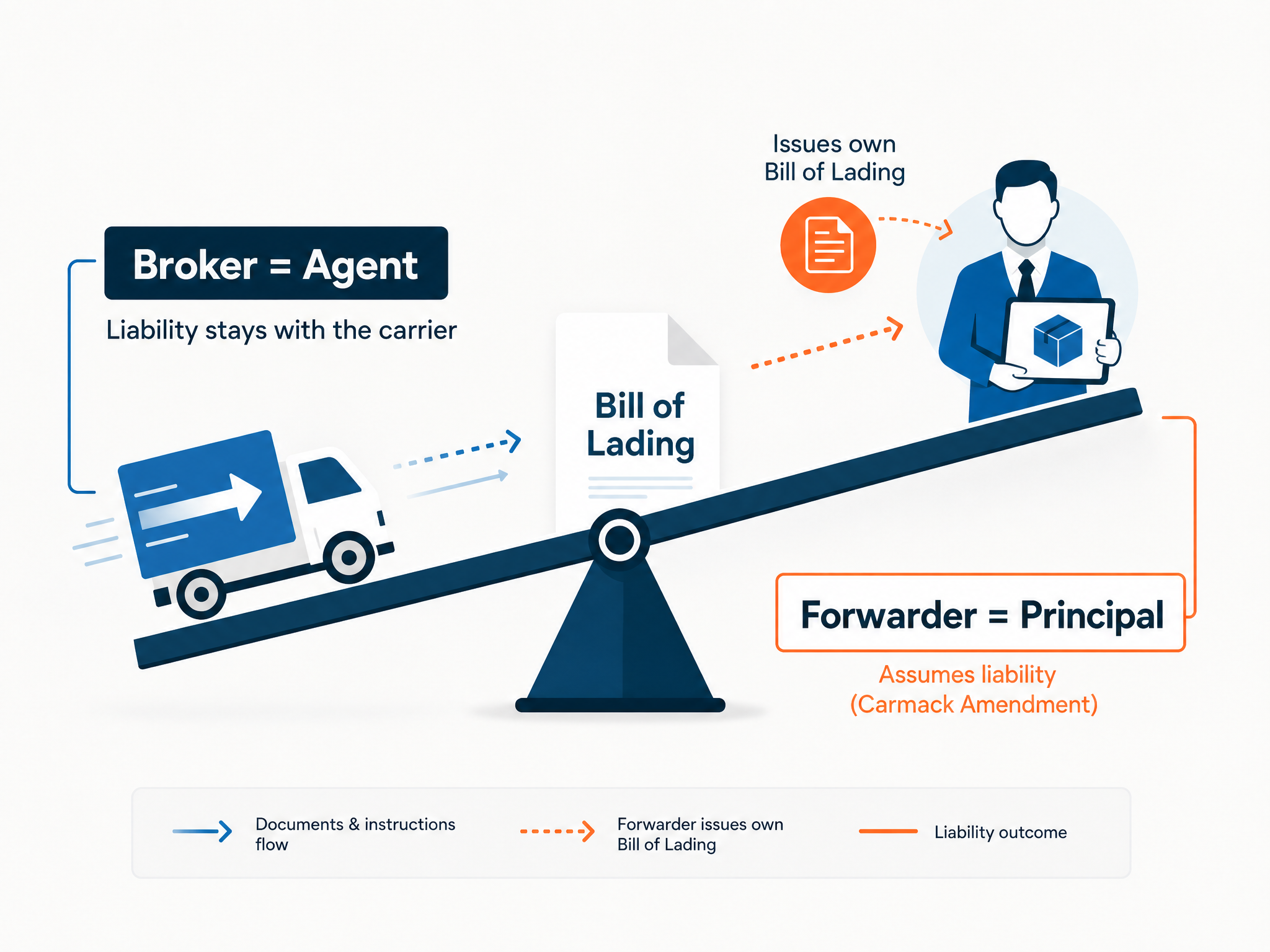
Legally, a broker is an agent that arranges transportation; a forwarder is a principal carrier that issues its own bill of lading. The pivotal statute is the Carmack Amendment. Under 49 U.S.C. § 14706, it defines a "carrier" to include a freight forwarder, so forwarders face near strict liability for cargo loss: a shipper generally need not prove negligence, only that the loss happened in transit.
Brokers sit outside that regime. Because a broker is not a carrier under the statute, the Carmack Amendment does not impose cargo liability on brokers that merely arrange transportation; a broker is usually liable only where negligence, such as poor carrier selection, is proven. Forwarders also carry higher third-party tort exposure, since their hired carriers are more likely to be treated as subcontractors. The table below distills the contrasts:
| Factor | Freight Broker | Freight Forwarder |
| Legal role | Agent that arranges transport | Principal carrier that moves freight |
| Possession | Never takes possession | Takes possession; consolidates |
| Bill of lading | Does not issue its own | Issues its own |
| Cargo liability | Not liable unless negligence proven | Strict liability (Carmack Amendment) |
| Best for | Domestic truckload and LTL | Consolidated or multi-modal moves |
Licensing and Regulatory Requirements
Both brokers and freight forwarders must register with the FMCSA, pay the same filing fee, designate process agents, and maintain a $75,000 financial guarantee.
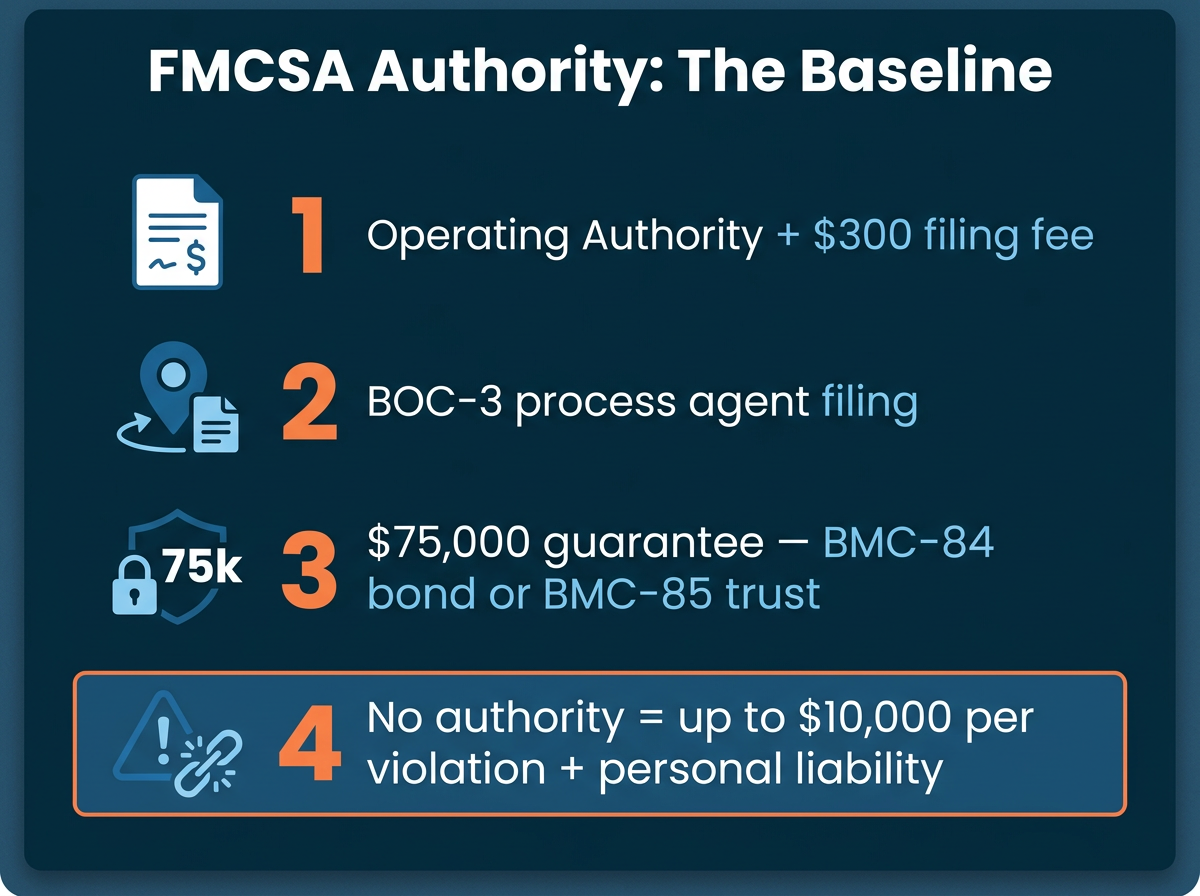
Both roles require federal operating authority from the FMCSA, and the core requirements overlap:
- File for operating authority and pay a one-time $300 filing fee per authority type.
- Submit a BOC-3 filing, which designates a process agent in every state of operation; authority will not activate until it is on file.
- Maintain a $75,000 guarantee, either a BMC-84 surety bond or a BMC-85 trust fund.
The penalties are steep. Operating without proper authority carries a civil penalty of up to $10,000 per violation under 49 U.S.C. § 14916, with officers and principals personally liable. The rules have also tightened: under 2024 FMCSA rules, BMC-85 trusts must hold qualifying liquid assets by a January 16, 2026 deadline, squeezing out thinly capitalized intermediaries.
Insurance Complexities
Standard cargo insurance is often inadequate for brokerage and forwarding operations, and each role requires a distinct set of liability policies.
The right coverage depends on the role, and a standard cargo form rarely fits. A broker typically needs Contingent Motor Truck Cargo coverage or Freight Broker Legal Liability protection, which respond when a contracted carrier's primary policy does not. A forwarder, because it issues its own bill of lading and holds custody, needs carrier-grade policies such as Carrier's Legal Liability and, where it stores freight, Warehouse Legal Liability.
Getting this wrong cuts both ways: misrepresenting operations on an application can mean denied claims when you need coverage, or overpaid premiums for protection that doesn't fit, a problem sharpest for companies blending both activities. It matters more today: the Transportation Intermediaries Association reports that organized freight theft has risen more than 1,500% since 2021, with losses as high as $35 billion a year. Confirming a partner's coverage matches its real role is basic due diligence.
When the Lines Blur: Holding Multiple Authorities
A single company can legally hold both broker and forwarder authority at once, and its role is determined shipment by shipment, not by the label on its letterhead.
One entity can hold both authorities, and many do; the FMCSA acknowledges that a company's operations may warrant holding both forwarder and broker authority. But that does not let a provider pick whichever liability standard is convenient after a loss. The role is set shipment by shipment: issue your own bill of lading and hold yourself out as the carrier on a load, and you are a forwarder on that shipment, with the strict liability that follows.
Courts classify by public conduct, not internal labeling. When the broker-versus-carrier line is disputed, courts examine how the company held itself out and its relationship to the shipper. Even marketing as an all-in-one transportation provider can be enough to have a self-described broker treated as a carrier in a cargo claim. Be deliberate and consistent about the role you play on every load.
How Freight Forwarders Differ from Other Logistics Entities
Surface freight forwarders are legally distinct from customs brokers, ocean intermediaries (NVOCCs), and air intermediaries (IACs), even though all are loosely called "forwarders."

A surface freight forwarder is not the same as the intermediaries it is often grouped with. The most common mix-up is the customs broker, a different role entirely: a customs broker is licensed by U.S. Customs and Border Protection to handle entries, duties, and tariff classification and does not move freight. Surface forwarders are also distinct from ocean and air intermediaries; as logistics counsel caution, do not confuse surface forwarders with Indirect Air Carriers (IACs) or Non-Vessel Operating Common Carriers (NVOCCs), which fall under separate laws. A quick map:
- Surface freight forwarder — moves domestic surface freight; registers with the FMCSA.
- NVOCC — ocean intermediary that issues its own house bill of lading; licensed by the Federal Maritime Commission.
- Indirect Air Carrier (IAC) — air-cargo intermediary regulated under TSA security rules.
- Customs broker — files customs entries and advises on duties under CBP authority.
The takeaway: "freight forwarder" is not one universal license. The right partner depends on your shipping mode and the specific authority the provider holds.
Choosing the Right Partner: The Bottom Line
Match the partner to the shipment: brokers fit straightforward domestic truckload and LTL, while forwarders fit consolidated, multi-modal, or hands-on freight, and the rate alone should never decide it.
We wrote this guide because the broker-versus-forwarder question comes up constantly, and getting it wrong has real consequences for cost, control, and liability. The choice follows from your shipment. For straightforward domestic freight by truckload or LTL, a broker is usually the most efficient partner. For shipments needing handling, consolidation, warehousing, or multiple modes, a forwarder fits better. A few best practices:
- Verify authority and bonding for the role the provider is actually playing.
- Look past the rate to total landed cost, including handling, documentation, and liability.
- Pin down liability and insurance so coverage matches who is responsible for the cargo.
At Alpha Zero Logistics, this is the analysis we run for customers every day, structuring each move around the right model, coverage, and carriers. If you want help deciding what your supply chain needs, explore our Managed Transportation Services and Freight Brokerage Services, and let our team build a solution around your freight.
Sources
- Federal Motor Carrier Safety Administration, "What are the definitions of motor carrier, broker and freight forwarder authorities?". https://www.fmcsa.dot.gov/faq/what-are-definitions-motor-carrier-broker-and-freight-forwarder-authorities
- Federal Motor Carrier Safety Administration, "Types of Operating Authority.". https://www.fmcsa.dot.gov/registration/types-operating-authority
- Federal Motor Carrier Safety Administration, "Form BOC-3 — Designation of Agents for Service of Process.". https://www.fmcsa.dot.gov/registration/form-boc-3-designation-agents-service-process
- Mordor Intelligence, "United States Freight Brokerage Market Size, Growth Drivers, Forecast.". https://www.mordorintelligence.com/industry-reports/united-states-freight-brokerage-market
- Logistics Law (Benesch), "Five Things You Should Know About Logistics Law — Forwarders.". https://logisticslaw.net/category/forwarders/
- Logistics Law (Benesch), "Differences Between a Freight Broker and Surface Freight Forwarder.". https://logisticslaw.net/2022/05/31/differences-broker-forwarder/
- Falvey Insurance Group, "When Are Freight Brokers Liable in Cargo Claims?". https://falveyinsurancegroup.com/claims-loss-prevention-recoveries/when-are-freight-brokers-liable-in-cargo-claims/
- Mathis Law Group, "5 Keys to Broker Protection From Carmack Amendment Claims.". https://www.mathislawgroup.com/blog/2025/03/5-keys-to-broker-protection-from-carmack-amendment-claims/
- SuretyBonds.com, "How to Get a Freight Broker License.". https://www.suretybonds.com/guide/federal/freight-broker-license
- Safe Road Compliance, "FMCSA Operating Authority Types: MC, MX, & FF Numbers.". https://saferoadcompliance.com/blog/fmcsa-operating-authority-types/
- Roanoke Group, "Cargo Legal Liability Insurance.". https://www.roanokegroup.com/solutions/cargo-legal-liability-insurance/
- U.S. Customs and Border Protection, "Becoming a Customs Broker."
https://www.cbp.gov/trade/programs-administration/customs-brokers/becoming-customs-broker - Inbound Logistics, "Risky Business: Inside the Freight Fraud Surge.". https://www.inboundlogistics.com/articles/risky-business-inside-the-freight-fraud-surge/