
Supply Chain Optimization Strategies
TL;DR: Supply chain optimization is the ongoing process of improving how goods move from raw material to end customer—balancing cost, speed, service, and risk. In this guide, we walk through the six key stages of optimization, the technology that enables it, sustainability best practices, essential KPIs, common trade-offs, and real-world examples that show what effective logistics optimization looks like in practice.
Supply chain optimization means fine-tuning every link in your chain—from demand planning to last-mile delivery—so the entire network runs leaner, faster, and more reliably. At Alpha Zero Logistics, we partner with shippers across industries to improve supply chain efficiency and build networks that perform under pressure.
The need has never been more urgent. According to the Business Continuity Institute, nearly 80% of organizations experienced at least one supply chain disruption in the past twelve months. Volatility, customer expectations, capacity constraints, and margin pressure are forcing companies to rethink operations.
Effective supply chain optimization also depends on breaking down data silos across procurement, operations, warehousing, and transportation. When teams share real-time information and align around the same service, cost, and inventory goals, organizations can respond faster to disruptions and changing customer demand.
Benefits and Importance of Supply Chain Optimization
An optimized supply chain reduces costs, improves delivery performance, and builds the resilience needed to weather disruptions—delivering measurable value across the entire organization.
What Businesses Gain
Companies that invest in supply chain optimization unlock advantages that compound over time. McKinsey calculates that disruptions can cost companies roughly 45% of one year’s profits over a decade, making proactive optimization a financial imperative. Key gains include:
- Lower transportation and warehousing costs through transportation optimization, route consolidation, and smarter mode selection.
- Improved order accuracy and shorter lead times driven by better demand planning and inventory positioning.
- Stronger supplier relationships built on performance visibility and collaborative forecasting.
- Greater supply chain efficiency that frees up working capital and reduces waste across the network.
Who Benefits Internally
Optimization creates ripple effects across departments. Operations gains smoother workflows and fewer bottlenecks. Finance sees improved working capital through better inventory management. Procurement strengthens supplier performance and negotiating leverage. Sales and customer experience benefit from reliable delivery promises they can keep.
Key Stages of Supply Chain Optimization (With Best Practices)
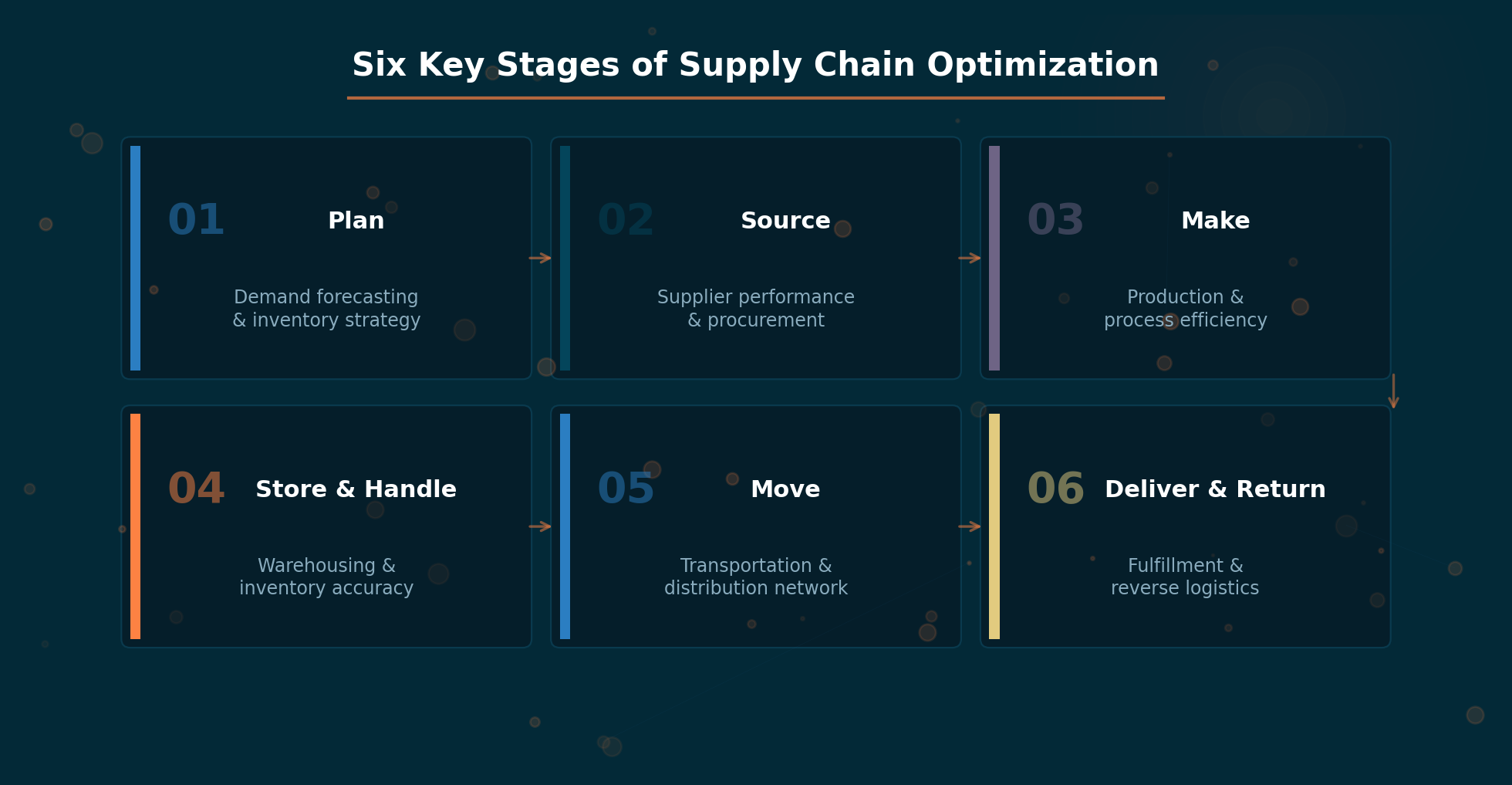
Optimization spans six interconnected stages. Improving one stage without considering the others can create new bottlenecks, so a holistic approach is essential.
1) Plan: Demand, Supply, and Inventory Strategy
Effective optimization starts with planning. Use demand sensing tools and collaborative forecasting with key customers to reduce forecast error. Align inventory policies to service-level targets by SKU segment—not a blanket approach. We help clients build planning frameworks that connect demand signals directly to replenishment logic.
2) Source: Supplier Performance and Procurement
Evaluate suppliers on quality, lead time, and risk—not just price. Diversify your supplier base for critical components to avoid single points of failure. According to a BCI report, 43.6% of organizations experienced disruption from third-party failures, underscoring the importance of supplier visibility beyond tier one.
The strongest supply chains go beyond supplier scorecards and build real collaboration into the process. Shared forecasts, supplier inventory management, and more transparent communication help reduce production delays, inventory shortages, and supply-demand mismatches before they affect customers.
3) Make: Production and Process Efficiency
Lean manufacturing principles, standardized work instructions, and real-time production monitoring reduce waste and improve throughput. Focus on cycle-time reduction and first-pass yield to keep production costs in check while maintaining quality standards.
4) Store & Handle: Warehousing and Inventory Accuracy
Warehouse slotting optimization, cycle counting, and barcode or RFID verification improve pick accuracy and reduce mis-ships. Our warehousing and distribution services are designed to help clients maintain inventory accuracy above 99% while maximizing throughput.
5) Move: Transportation and Distribution Network
Transportation often represents the largest controllable cost in the supply chain. Consolidate shipments, optimize routes, and use mode selection strategically. Our managed transportation services leverage network analytics and transportation optimization to identify savings while maintaining on-time delivery commitments.
6) Deliver & Return: Fulfillment and Reverse Logistics
Last-mile delivery and returns handling directly shape customer experience. Implement clear return policies, automate disposition decisions, and track reverse logistics costs separately.
Technology and Innovation in Supply Chain Optimization
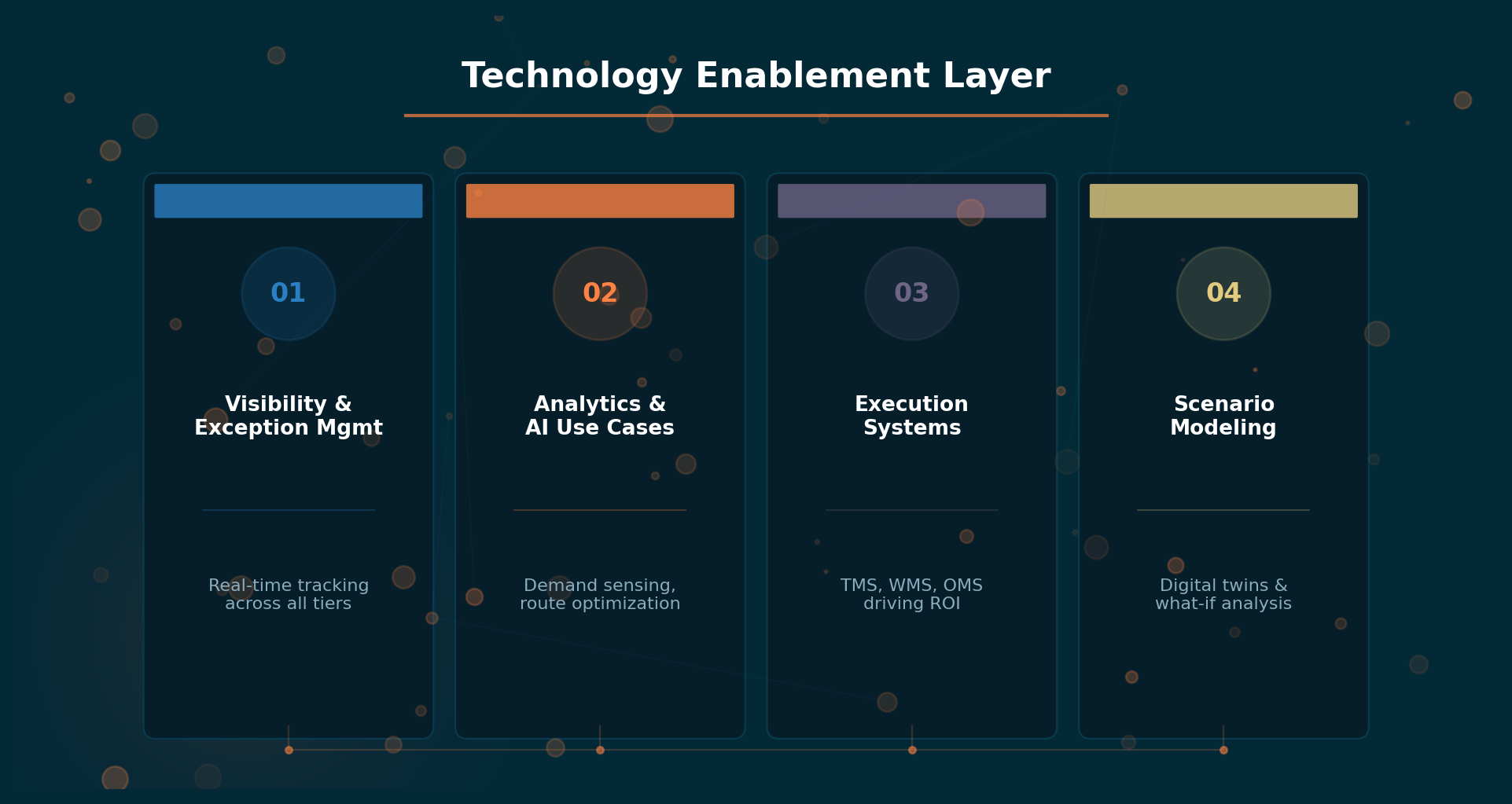
Technology is the enablement layer that connects strategy to execution. The right tools amplify every optimization effort—from logistics optimization to end-to-end visibility.
Visibility and Exception Management
Real-time tracking across carriers, warehouses, and suppliers allows teams to manage by exception rather than manually monitoring every shipment. We invest in visibility tools that give our clients a single view of their freight, no matter how many carriers or modes are in play.
Analytics and AI Use Cases
AI-powered demand sensing, predictive ETAs, carrier scoring, and dynamic pricing models help supply chain teams make faster, more accurate decisions. According to McKinsey, “Successfully implementing AI-enabled supply-chain management has enabled early adopters to improve logistics costs by 15 percent, inventory levels by 35 percent, and service levels by 65 percent.” The key is feeding these tools clean, consistent data.
Execution Systems That Drive ROI
Transportation management systems (TMS), warehouse management systems (WMS), and order management systems (OMS) are the execution backbone. When properly integrated, they automate routine decisions, reduce manual errors, and provide the audit trail needed for continuous improvement.
Integration matters just as much as the tools themselves. A connected stack—whether through EDI, APIs, or a broader B2B integration platform—helps unify TMS, WMS, OMS, ERP, and supplier data into a more complete view of the network. That end-to-end visibility improves decision-making, reduces fragmented systems, and supports faster exception management across partners.
Scenario Modeling
Digital twins and what-if analysis allow supply chain leaders to test network changes, capacity shifts, or supplier disruptions before they happen. Scenario modeling turns reactive firefighting into proactive risk management.
Sustainability in the Supply Chain
Sustainability and efficiency are not opposing forces. The highest-impact green initiatives often deliver cost savings at the same time.
High-Impact Levers That Also Improve Efficiency
The best sustainability strategies double as transportation optimization strategies. We build these levers into every logistics plan at Alpha Zero:
- Route optimization reduces both fuel costs and carbon emissions.
- Packaging right-sizing cuts material waste and lowers dimensional weight charges.
- Shipment consolidation means fewer trucks on the road and lower per-unit costs.
- Mode shifting from air to ground or intermodal where transit times allow saves money and reduces environmental impact.
Measurement and Governance
Track Scope 1, 2, and 3 emissions across your supply chain. Establish governance structures that assign accountability for sustainability targets alongside cost and service goals. Frameworks like the GHG Protocol provide standardized measurement.
Metrics and Performance Measurement
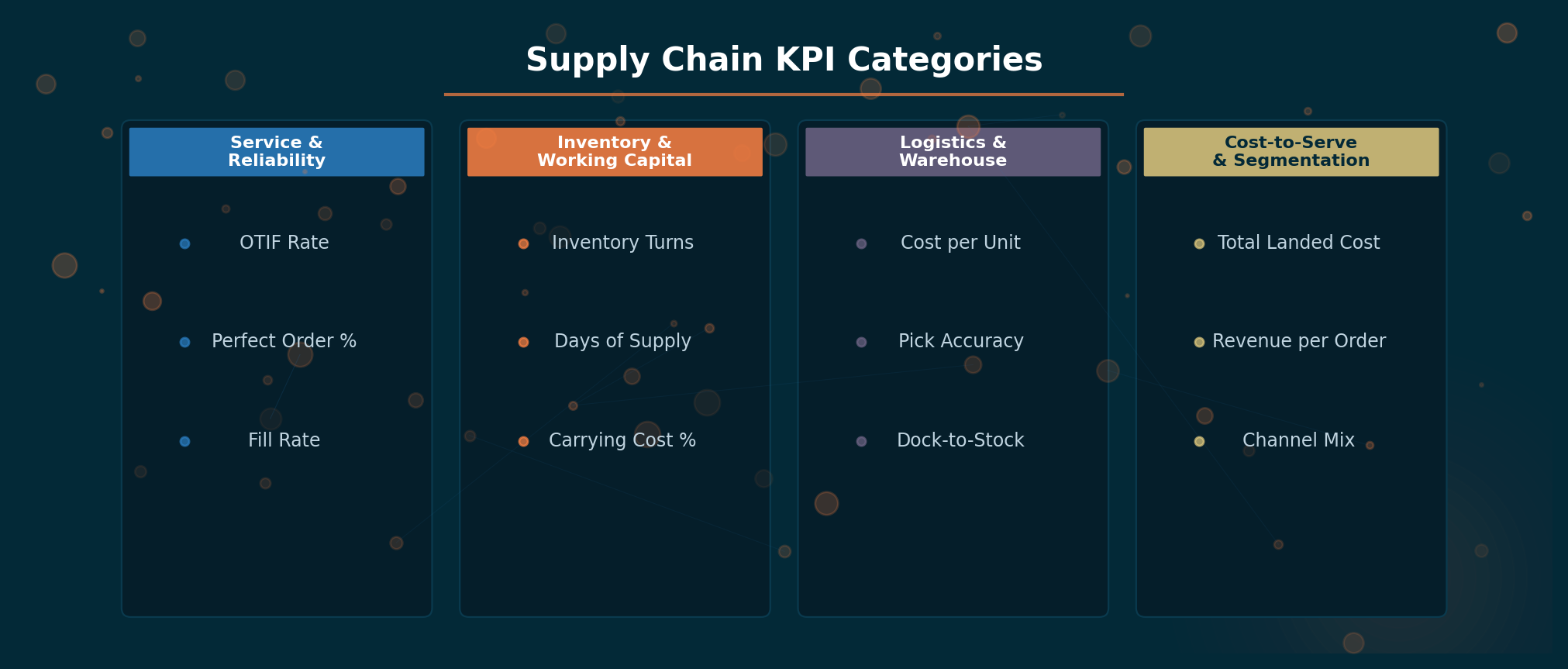
You can’t optimize what you don’t measure. A balanced scorecard of KPIs across four categories gives you the full picture of supply chain efficiency.
Core Service and Reliability KPIs
On-time in-full (OTIF) rate, perfect order percentage, and fill rate measure how well you deliver on promises. These are the KPIs your customers feel directly, and they should anchor every optimization conversation.
Inventory and Working-Capital KPIs
Inventory turns, days of supply, and carrying cost as a percentage of inventory value reveal how efficiently you deploy capital. Higher turns generally signal better demand-supply alignment.
Logistics and Warehouse KPIs
Cost per unit shipped, pick accuracy, and dock-to-stock time track operational efficiency inside your logistics network. Benchmarking against industry standards helps identify improvement areas.
Cost-to-Serve and Segmentation
Total landed cost by customer, channel, or product segment exposes where you make money and where you don’t. KPMG notes that understanding cost-to-serve at a granular level is essential for protecting margins in an environment of persistent inflation.
Common Challenges and Trade-offs (And How to Handle Them)
Every optimization decision involves trade-offs. Recognizing these tensions—and managing them deliberately—separates good supply chains from great ones.
Speed vs. cost: Faster delivery costs more. Reduce expediting by improving forecast accuracy and positioning inventory closer to demand.
Lean inventory vs. resilience: Less stock saves money but increases stockout risk. Safety stock buffers are justified for high-margin or high-criticality items.
Standardization vs. flexibility: Global SOPs drive consistency, but controlled exceptions are needed for regional requirements or key customers.
Data quality and tool overload: New systems on poor data foundations create expensive confusion. Fix master data before layering on technology.
Supplier dependency and concentration risk: Single-source suppliers deliver short-term savings but amplify disruption risk. Dual-sourcing critical inputs is a prudent hedge.
Real-World Examples and Use cases
These composite scenarios, drawn from common patterns we see across our client base, illustrate how targeted optimization efforts deliver measurable results.
Inventory segmentation: A consumer goods manufacturer segments SKUs by velocity and margin, applying different replenishment rules to each tier. This approach commonly yields double-digit improvements in inventory turns without degrading service levels.
Transportation consolidation: A building materials distributor consolidates LTL shipments into multi-stop truckloads. McKinsey research on AI in distribution operations reports that logistics optimization can reduce costs by 5–20%, and consolidation is one of the fastest ways to capture those savings.
Warehouse slotting: A food and beverage company re-slots its distribution center based on order frequency data. McKinsey notes that AI-powered tools can unlock 7–15% additional warehouse capacity and meaningfully improve pick rates.
Network redesign: A retailer shifts from a single national DC to regional fulfillment centers, reducing average transit time while keeping logistics cost flat—one of the most powerful levers in supply chain optimization.
Conclusion
Supply chain optimization is not a one-time project—it is an ongoing discipline that compounds over time. By approaching it stage by stage, investing in the right technology, measuring what matters, and confronting trade-offs honestly, companies build supply chains that are faster, leaner, and more resilient.
At Alpha Zero Logistics, we turn these strategies into operational reality. Whether you need transportation optimization, warehouse efficiency, logistics optimization, or end-to-end network design, our team delivers results. Explore our full range of services or contact us today to start optimizing your supply chain.
Citations
- Business Continuity Institute. (2024). Supply Chain Resilience Report 2024. https://www.thebci.org/news/supply-chain-disruptions-drive-increased-tier-mapping-and-insurance-uptake.html
- Conexiom. (2023). The Cost of Supply Chain Disruptions: 20+ Statistics. https://conexiom.com/blog/the-cost-of-supply-chain-disruptions-20-statistics/
- McKinsey & Company. (2021). Succeeding in the AI Supply-Chain Revolution. https://www.mckinsey.com/industries/metals-and-mining/our-insights/succeeding-in-the-ai-supply-chain-revolution
- McKinsey & Company. (2024). Harnessing the Power of AI in Distribution Operations. https://www.mckinsey.com/industries/industrials/our-insights/distribution-blog/harnessing-the-power-of-ai-in-distribution-operations
- KPMG. (2025). Six Supply Chain Trends to Watch in 2025. https://kpmg.com/us/en/articles/2025/supply-chain-trends-2025.html