

What Is a 4PL? (4PL vs 3PL Explained)
Shippers keep asking us: do we need a 3PL, a 4PL, or both? The answer shapes who owns the strategy when something goes wrong. Below, we define fourth-party logistics, walk the 1PL-to-5PL hierarchy, and share how to choose.
TL;DR: A 3PL executes logistics — moving, storing, and shipping freight. A 4PL orchestrates — designing the network, managing 3PLs, and giving you one point of accountability. Most companies start with 3PL and add 4PL coordination as complexity grows.
Quick Definitions: 3PL vs 4PL (At a Glance)
The 4PL logistics meaning is simple: a 3PL handles execution, a 4PL handles orchestration. The 3PL operates the assets; the 4PL manages the strategy and technology layered above them.
A third-party logistics provider (3PL) performs specific functions: warehousing, transportation, brokerage, fulfillment, and returns. According to Armstrong & Associates, the U.S. 3PL market has grown to $323.4 billion, with 94% of Fortune 500 companies using a 3PL — up from 46% in 2001.
A fourth-party logistics provider (4PL), or Lead Logistics Provider (LLP), sits one level above. The term was coined in 1996 by Andersen Consulting (now Accenture) to describe a supply chain integrator combining its own resources with complementary providers. In practice, the 4PL is your control tower — the role we play through our Managed Transportation Services.
The Distribution Hierarchy: 1PL to 5PL
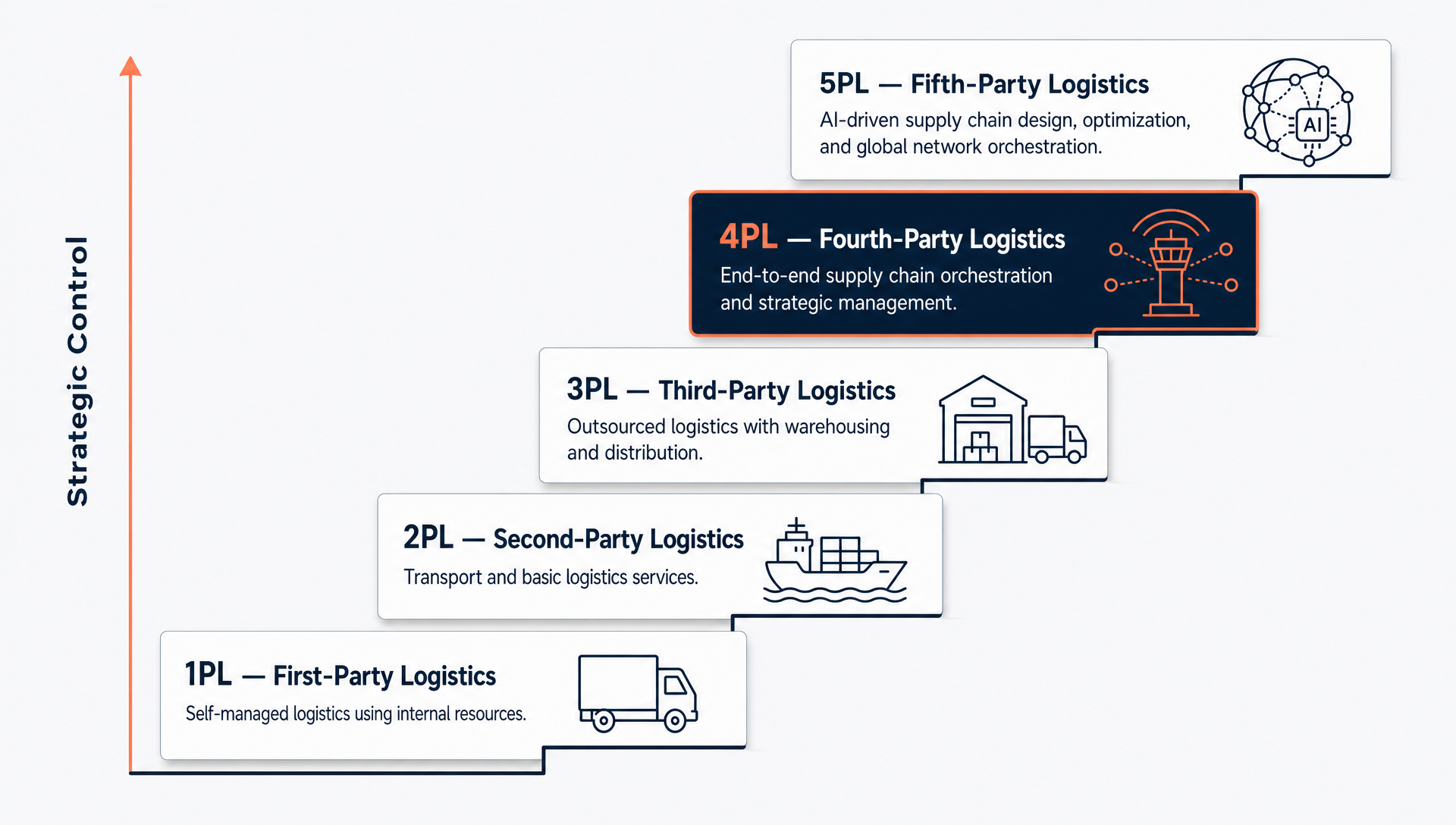
Logistics maturity is mapped on a 1PL-to-5PL spectrum, with each step outsourcing more strategic control.
1PL (First-Party Logistics)
A 1PL handles its own logistics in-house — a manufacturer with its own trucks, drivers, and warehouse delivering to customers.
2PL (Second-Party Logistics)
A 2PL is an asset-based carrier hired for one mode of transport — an ocean line or trucking company. The shipper still manages logistics.
3PL (Third-Party Logistics)
A 3PL bundles multiple logistics functions — warehousing, transportation, brokerage, customs — under one roof. The shipper retains strategy; the 3PL executes.
4PL (Fourth-Party Logistics)
A 4PL owns the entire supply chain. It typically doesn't own warehouses or trucks; it manages the 3PLs that do, plus carriers, technology, and vendors.
5PL (Fifth-Party Logistics)
A 5PL coordinates multiple supply chains with big data, AI, and aggregated buying power. 5PLs are most common in e-commerce ecosystems.
Key Differences Between 3PL and 4PL
The cleanest way to separate 3PL and 4PL is across three dimensions: scope and accountability, assets and neutrality, and technology and visibility.
Differences by Scope and Accountability
A 3PL owns its function—warehouse or transport KPIs —whereas a 4PL owns the end-to-end outcome and is your single point of contact. According to Armstrong & Associates, Volkswagen works with 74 distinct 3PLs and Walmart with 72 — the complexity that drives 4PL coordination.
Differences by Assets and Neutrality
Most 3PLs operate physical assets — trucks, warehouses, and automation. That base enables fast execution but can bias network design toward what they already own. 4PLs are typically asset-light and neutral, recommending what's genuinely best for your freight. We deliver both modes for clients.
Differences by Technology and Visibility
A 3PL's tech stack focuses on its own four walls; a 4PL aggregates data from every 3PL, carrier, and ERP into one control tower. The 2025 Annual Third-Party Logistics Study found 69% of shippers cite supply chain visibility as the top area needing change — the gap a 4PL closes.
Process Flows and Service Offerings
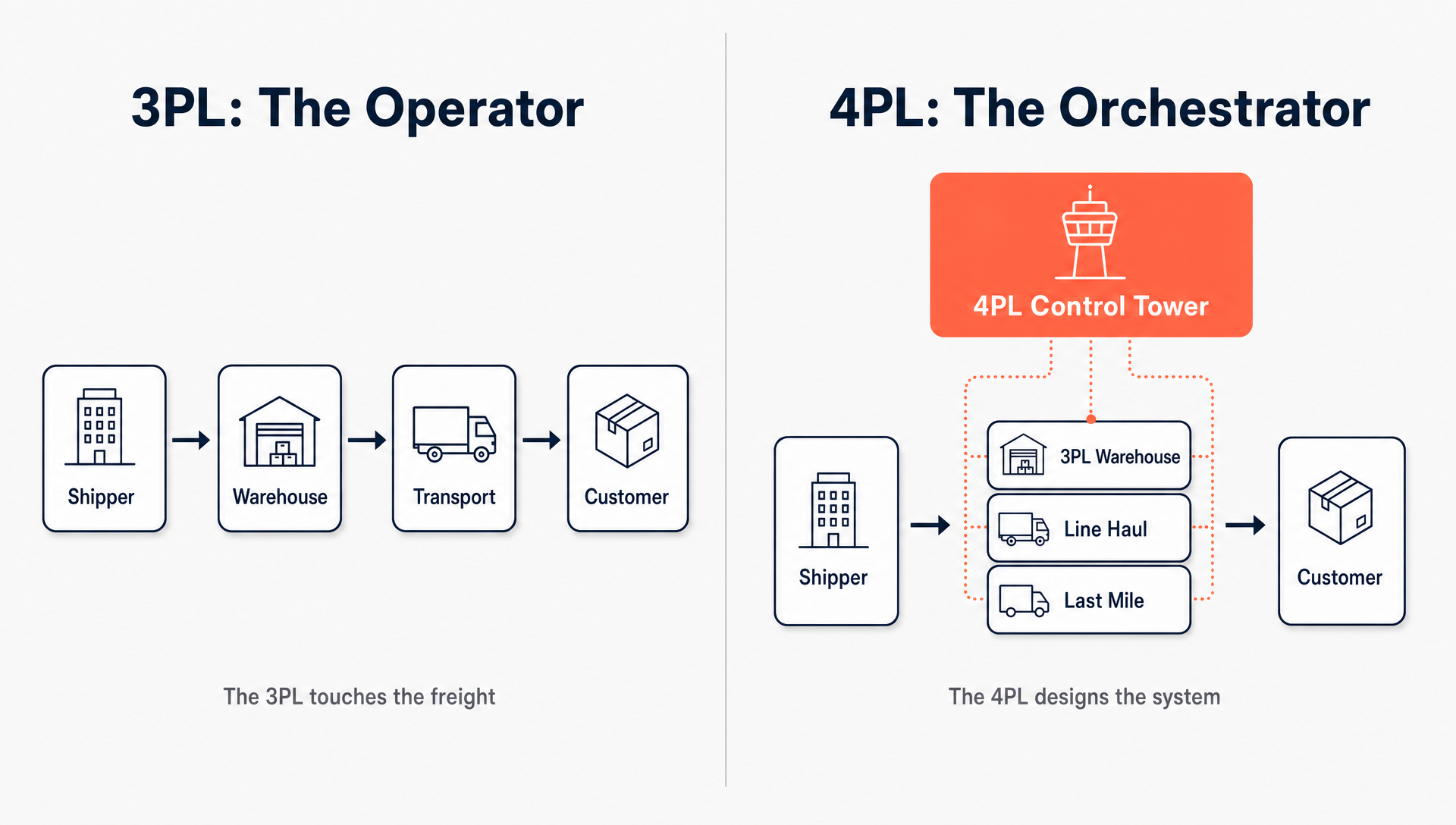
The 3PL touches the freight; the 4PL designs the system that decides where it goes.

When a 3PL Is the “Operator”
The 3PL receives goods, stores them, picks and packs orders, and tenders shipments. A typical catalog includes truckload and LTL transportation, Warehousing & Distribution, brokerage, customs, and reverse logistics. Our 3PL services span dry van, flatbed, refrigerated, and expedited freight, plus warehousing and on-site logistics.
When a 4PL Is the “Orchestrator”
The 4PL designs the network, sources providers, integrates technology, and reports results. Standard 4PL services include network optimization, TMS deployment, freight audit and payment, and transportation analytics. We deliver these through our Managed Transportation Services (MTS) practice.
Advantages and Disadvantages of 3PL vs 4PL
Both models trade off control against complexity. A 3PL keeps more internal authority; a 4PL simplifies the org chart but adds separation from execution.
3PL Advantages and Disadvantages
Advantages: lower cost to start, scalable capacity, deep operational expertise, and faster onboarding. Industry research finds 82% of shippers say 3PLs improve customer service and 66% say they reduce overall costs. Disadvantages: With many 3PLs, internal teams must coordinate them when handoffs fail.
4PL Advantages and Disadvantages
Advantages: a single point of contact, neutral network design, integrated data, and end-to-end accountability. Industry research projects the global 4PL market to nearly double from $62 billion in 2023 to $121 billion by 2033 — growth we see in our own pipeline. Disadvantages: a 4PL adds a layer between shipper and execution, which can dilute control if governance is weak; contracts also tend to be longer.
| Factor | 3PL | 4PL |
|---|---|---|
| Primary role | Execution | Orchestration |
| Asset ownership | Often asset-based | Typically asset-light |
| Scope | One or more functions | Entire supply chain |
| Single point of contact | No (per function) | Yes |
| Best fit | Operational outsourcing | Strategic outsourcing |
How 3PL and 4PL Work Together
In real networks, 3PL and 4PL aren't either-or — the 4PL coordinates a roster of 3PLs underneath. The roles complement each other.
The Most Common Operating Model
The shipper contracts a 4PL to design and govern the network. The 4PL manages multiple 3PLs that execute warehousing, line-haul, last-mile, and specialty services.
What “Good Collaboration” Looks Like
Three signals show up consistently: shared visibility (every party reads from the same data), clear accountability (the 4PL owns network outcomes, the 3PL owns function-level SLAs), and regular business reviews pairing analytics with frontline insight.
Common Pitfalls (and How to Prevent Them)
The two issues we see most: overlapping scopes — gaps and finger-pointing follow when responsibilities aren't documented — and shadow data, where each 3PL keeps its own truth. Both are preventable with a governance charter and an integrated TMS.
Choosing the Right Logistics Model for Your Business
The right model depends on supply chain complexity, in-house capability, growth trajectory, and how much control you want to retain.
Decision Factors Checklist
Use this list to pressure-test which model fits your stage of growth:
- Network complexity: More than three to five carriers or facilities? Consider 4PL coordination.
- Internal expertise: No dedicated logistics team? A 4PL absorbs that burden.
- Volume volatility: Seasonal swings? A 4PL's neutral design lets you flex without re-bidding.
- Visibility gap: Can't get one view of inventory and freight? That's a 4PL problem.
- Budget horizon: 4PL relationships typically run three to five years.
Questions to Ask Before You Sign
- How will you measure end-to-end performance, not just function-level SLAs?
- Which 3PLs and carriers will you use, and how is selection governed?
- What technology is included, and who owns the data?
- How is pricing structured — gainshare, fixed fee, or cost-plus?
- What's the exit clause if priorities shift?
Conclusion: Pick the Model That Matches Your Network
A 3PL is the right answer when execution is the gap; a 4PL is the right answer when coordination is the gap. Many growing companies need both.
The 3PL-versus-4PL question is framed as a competition, but the two layers complement each costother. We wrote this guide because clients ask us this every week — and the answer is rarely either-or. At Alpha Zero Logistics, we deliver 3PL execution — truckload, LTL, air, expedite, and Warehousing/Distribution — alongside 4PL orchestration via our Managed Transportation Services. If you're not sure which side you're on, talk to a logistics expert.
Sources
- Armstrong & Associates, Inc. (2026, April 28). Convergence: Trends in 3PL/Customer Relationships – 2026. https://www.einpresswire.com/article/908770600/armstrong-associates-releases-convergence-trends-in-3pl-customer-relationships-2026
- NTT DATA. 2025 Third-Party Logistics Study. https://us.nttdata.com/en/engage/2025-third-party-logistics-study
- Supply Chain 24/7. (2024, October 8). Study: 82% of Shippers See Improved Service with 3PL Partnerships. https://www.supplychain247.com/article/3pl-logistics-partnerships-study-NTT-data-penske
- Modula. (2026, January 6). 3PL vs. 4PL: Key Differences, How to Choose. https://modula.us/blog/3pl-vs-4pl-guide/
- SupplyChainManagementEdu.org. What Is 4PL in Supply Chain Management? https://supplychainmanagementedu.org/faq/what-is-4pl-in-supply-chain-management/
- ShipBob. 3PL vs 4PL: What Is a 4PL & How They Differ From 3PLs. https://www.shipbob.com/3pl/vs-4pl/