
So what does a freight broker do? A freight broker helps shippers move freight by connecting them with qualified carriers, negotiating rates, coordinating pickups and deliveries, managing communication, and helping solve problems while loads are in transit. Below, we explain what a broker does, how the process works, what makes one legitimate, and when a broker is enough versus when a more strategic partner makes sense.
TL;DR: A freight broker is a licensed intermediary that connects shippers with vetted carriers. Brokers usually don’t own trucks; they secure capacity, qualify carriers, negotiate rates, handle paperwork, track shipments, and manage problems in real time. Legitimate brokers hold FMCSA authority, an MC number, a $75,000 surety bond, and insurance. The payoff for shippers is a wider carrier network, cost and time savings, and better visibility — with managed transportation available when needs grow more complex.
What Is a Freight Broker?
A freight broker is a licensed intermediary that connects shippers who need to move goods with carriers that have the trucks and capacity to move them.
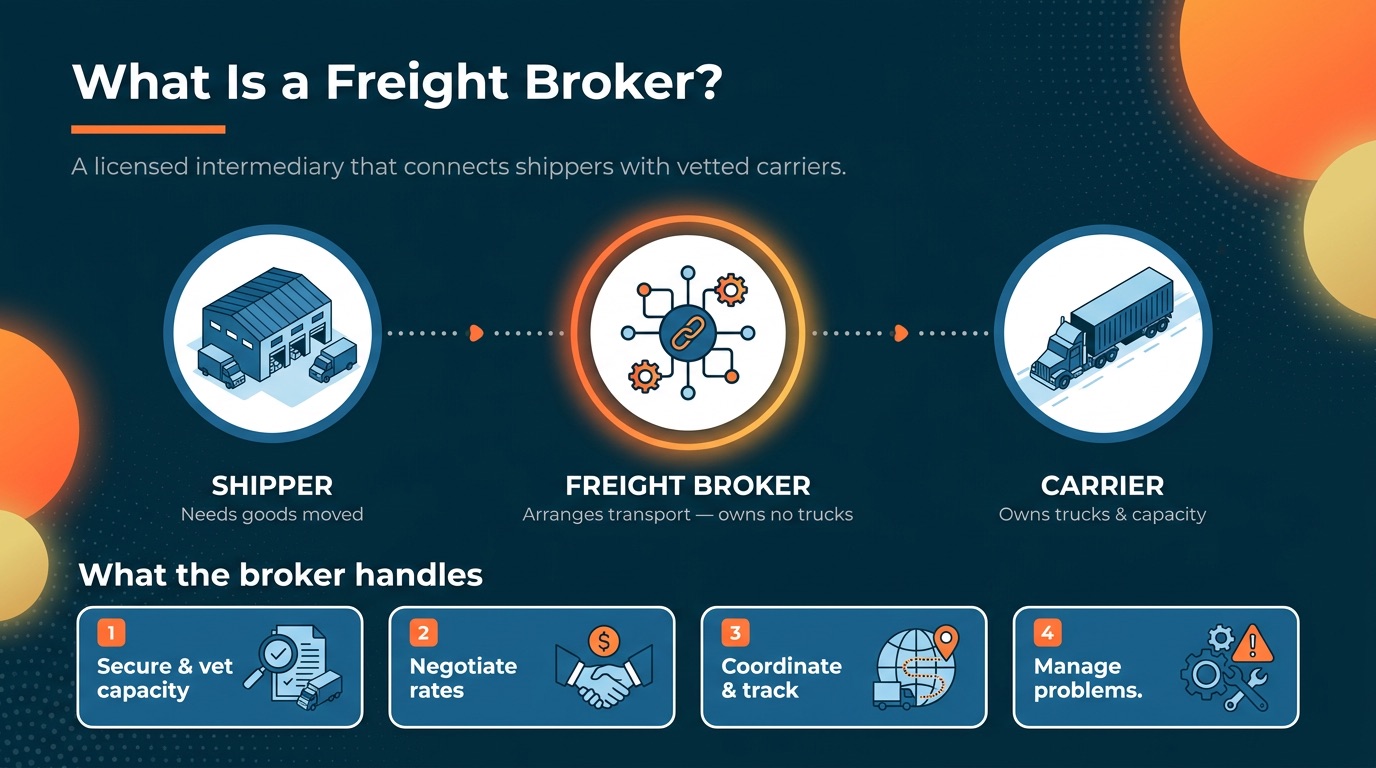
A broker sits between the shipper and the carrier, arranging transportation without hauling the freight. The broker doesn’t usually own the truck; it uses a carrier network to match each load to the right carrier. Schneider describes brokers as the bridge between businesses that need to ship and carriers with capacity.
The roles differ: a carrier owns trucks and moves freight, a broker arranges it, and a 3PL does both plus supply chain services. To operate legally, a broker holds operating authority from the FMCSA, an FMCSA license tied to an MC number (its MC authority), and stays in compliance.
Freight Broker Responsibilities: What a Broker Actually Handles
A broker secures capacity, vets carriers, negotiates rates, coordinates pickups and deliveries, prepares shipping documents, tracks freight, and manages problems and risk along the way.
A freight broker handles every task required to get a load from dock to door:
- Securing capacity and vetting carriers — a carrier qualification and vetting process confirming authority, safety scores, and insurance coverage.
- Negotiating rates — rate negotiation driven by market data.
- Coordinating pickups and coordinating deliveries.
- Creating shipping documents, including the bill of lading.
- Tracking shipments with real-time shipment tracking.
- Relationship management and problem-solving when plans change.
- Risk management — monitoring compliance and carrier reliability.
Freight brokers vet and manage carriers for capacity, reliability, and compliance before brokering freight to them. Our team connects shippers to 100,000+ vetted carriers.
Freight Brokerage Process: Step by Step
A shipment moves through a clear workflow: the order is received, requirements are reviewed, capacity is sourced, rates are negotiated, dispatch is finalized, paperwork is confirmed, freight is tracked, and billing closes the loop.
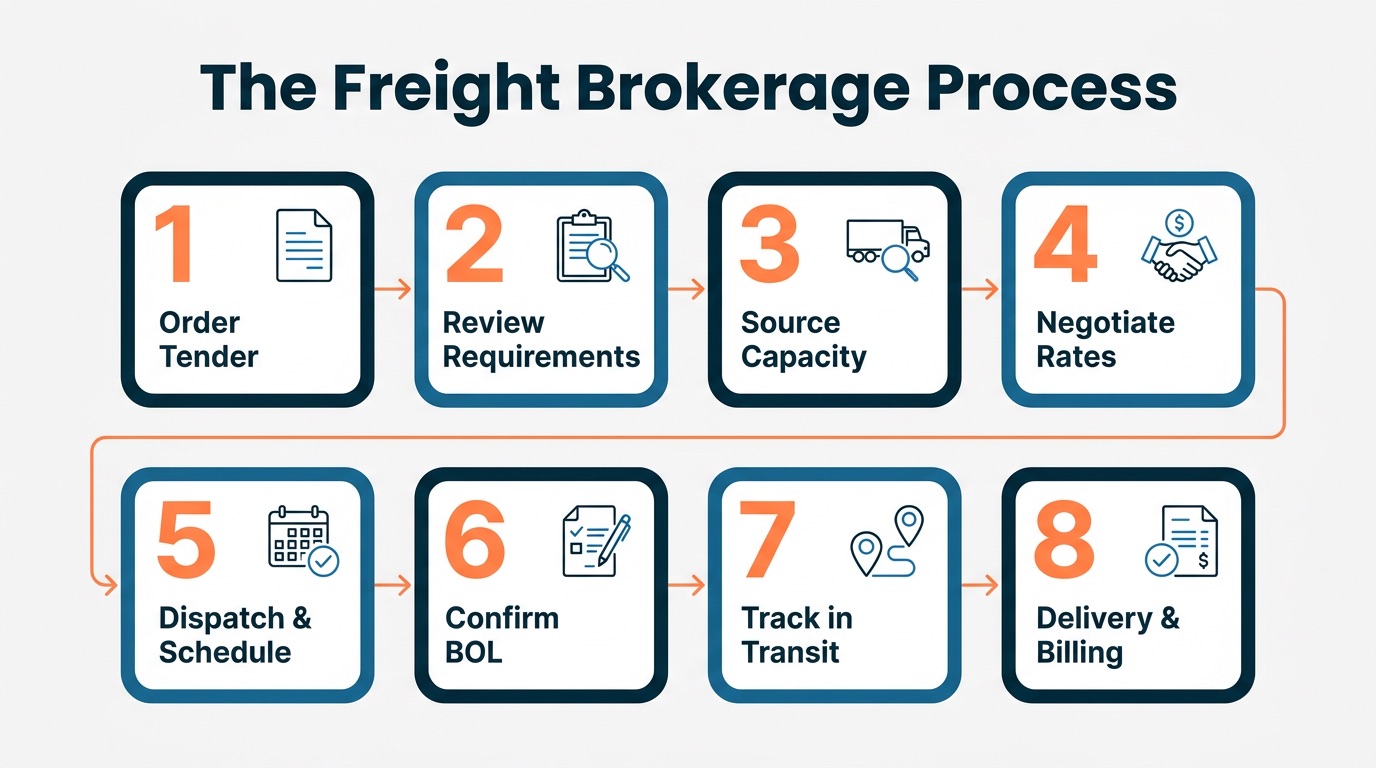
The process follows a repeatable sequence from order to invoice:
- Order tender received with load details.
- Requirements reviewed — commodity, weight, equipment, timing.
- Capacity sourced from the carrier network.
- Rates negotiated against the market.
- Dispatch finalized — dispatch and freight scheduling.
- Documents confirmed — the bill of lading (BOL).
- Shipment tracked via a freight management system.
- Delivery and back office — proof of delivery (POD), billing, and back-office tasks, with compliance management and risk-management protection throughout.
Benefits of Using a Freight Broker
Working with a broker gives shippers a wider carrier network, real cost and time savings, market rate data, more equipment options, and better visibility; all while reducing the burden on your team.
The main benefit is access to the capacity you couldn’t build alone. The carrier base is fragmented: more than 1.2 million active motor carriers operate in the U.S., and about 97% run fewer than 20 trucks. A broker aggregates that long tail into one point of contact:
- Wider carrier network and more equipment options.
- Cost savings through volume leverage and live market rate data (via a load board).
- Time savings and reduced internal burden.
- Route efficiency and supply chain flexibility.
- Real-time load tracking for better visibility.
Flock Freight notes brokers combine many shippers’ volume to negotiate lower rates and pass on the savings — a stronger bottom line and better ROI.
Finding and Choosing Freight Brokers
Choose a broker the way you would any critical partner: verify authority and insurance, review performance history and customer reviews, and watch for red flags like double brokering.
Evaluate compliance, capacity, and track record before handing over a load — a freight broker selection checklist:
- Verify authority and insurance — active FMCSA authority, surety bond, and insurance coverage.
- Review performance history — customer reviews, on-time record, and the depth of carrier relationships and capacity.
- Understand the vetting process and how they manage compliance and reliability.
- Watch for red flags — rates that seem too good to be true or signs of double brokering.
Fraud is a real concern: analysts report cargo-theft incidents and double-broker scams have surged, with average per-load losses topping $40,000. A legitimate broker can also point to its BOC-3 process agent filing.
Freight Broker vs Carrier vs 3PL
A broker arranges freight, a carrier moves it, and a 3PL offers broader transportation and supply chain support — including managed transportation for shippers who need a more strategic model.
The simplest way to tell them apart is by what each owns and manages:
| Role | What they do | Best when |
|---|---|---|
| Freight broker | Arranges freight and manages the logistics, documentation, and communication around each load. | You need flexible capacity sourced and managed per load. |
| Carrier | Owns the trucks and physically moves the freight. | You want to contract trucks directly. |
| 3PL / managed partner | Broader transportation and supply chain support: TMS visibility, analytics, dedicated account management. | You have recurring volume and want a transportation program, not spot loads. |
A shipper may need brokerage only when freight is occasional. As volume grows, a managed transportation model adds TMS visibility, analytics, and dedicated account management to run a coordinated transportation program.
Requirements and Qualifications: What Makes a Freight Broker Legitimate?
A legitimate freight broker holds FMCSA broker authority and an MC number, carries a $75,000 surety bond, files a BOC-3 process agent, and maintains insurance and a rigorous carrier vetting process.
A broker is legitimate when it holds the federal credentials the law requires. Brokers are regulated by the FMCSA. The core requirements:
- FMCSA license/broker authority with an MC number and operating authority.
- Freight broker surety bond — a $75,000 BMC-84 bond or BMC-85 trust fund guaranteeing carriers are paid.
- BOC-3 process agent designating a legal agent in each state.
- Insurance coverage and compliance standards, plus a documented carrier qualification and vetting process.
Authority won’t activate until the bond and BOC-3 are on file, so confirming these credentials is the clearest sign of a compliant partner.
Tools and Technology Freight Brokers Use
Modern brokers run on technology: a transportation management system (TMS), customer portals, real-time and GPS tracking, load boards, reporting and analytics tools, EDI, APIs, and quick-pay systems.

Technology lets a broker move fast and give shippers visibility:
- Transportation management systems (TMS) and a broader freight management system.
- Customer portal and real-time load tracking, often with GPS tracking.
- Load boards to source capacity quickly.
- Reporting software, data analysis tools, and optimization calculators.
- EDI software and APIs (electronic data integration and application programming interfaces) that connect systems.
- Quick pay / e-pay to settle carriers fast.
Platforms vary across the industry — some shippers recognize names like MySpot TMS — but the goal is the same. At Alpha Zero Logistics, technology supports our people: our platform connects load data, tracking, and carrier updates into one real-time view.
Do You Need a Freight Broker or a More Strategic Transportation Partner?
A broker is enough for occasional or simple freight. When shippers outgrow spreadsheets and transactional support, managed transportation often becomes the better fit.
Choose a broker when freight is occasional, and you mainly need capacity sourced load by load. But as volume grows and market conditions change, supply chain coordination becomes more complex. Outcomes also depend on the people involved — whether brokers work from office settings at a third-party employer or as your in-house team, their experience level shapes results. When a team is running freight from spreadsheets, a managed transportation model brings transportation analytics, dedicated account management, and scalability.
If your network has outgrown spreadsheets or internal bandwidth, our Managed Transportation Services bring structure, visibility, and accountability — strategy, daily execution, and continuous improvement.
A Brief Note on Freight Broker Careers and Industry Background
Becoming a freight broker involves training, FMCSA authority, and building a professional network — a stable career path, though our focus here is on what brokers do for shippers.
Briefly, how to become a freight broker comes down to a few steps: freight broker training, understanding freight regulations, and obtaining FMCSA authority before building a book of business. The freight broker job description centers on sourcing carriers, negotiating, and coordinating loads, and many a broker start-up guide walks through the same steps. Education and experience help, and most brokers grow a professional network of industry contacts over time. The work environment is typically office-based with a positive career outlook, and the average salary lands around $70,000 a year before commission.
Conclusion
A freight broker simplifies shipping by sourcing carriers, managing coordination, and improving flexibility and visibility — and the right partner can grow with you well beyond a single load.
A freight broker takes the hardest parts of shipping off your plate: finding dependable carriers, negotiating fair rates, handling paperwork, and keeping freight visible from pickup to delivery. At Alpha Zero, we deliver that brokerage muscle and, when you’re ready, a managed transportation model that brings strategy to the whole network. Whether you need one load covered or a program built to scale, talk to a logistics expert.
FAQs
Q1: What does a freight broker do for a shipper?
It connects the shipper with qualified carriers, negotiates rates, coordinates pickups and deliveries, prepares documents, tracks the load, and solves problems in transit — acting as one point of contact.
Q2: How do freight brokers find carriers?
Through their carrier network, relationships, and load boards, then qualifying each carrier for active authority, safety, and insurance before assigning the load.
Q3: Does a freight broker own trucks?
No. Brokers typically don’t own trucks or employ drivers; carriers physically move the freight.
Q4: What is the difference between a broker and a carrier?
A carrier owns the trucks and moves the freight. A broker arranges it and manages the rates, paperwork, tracking, and communication.
Q5: What qualifications should a freight broker have?
FMCSA broker authority and an MC number, a $75,000 surety bond, a BOC-3 process agent filing, and proper insurance, plus a documented vetting process.
Q6: What tools do freight brokers use?
A TMS, customer portals, real-time and GPS tracking, load boards, reporting and analytics tools, EDI, APIs, and quick-pay systems.
Q7: How do you choose a reliable freight broker?
Verify FMCSA authority and insurance, review performance history and reviews, ask about the vetting process, and watch for red flags like double brokering.
Q8: Can a small shipper benefit from working with a broker?
Yes. A broker gives small shippers access to a wide carrier network, market rate data, and volume leverage they couldn’t reach alone.
Sources
- FMCSA – Get MC Number / Operating Authority — https://www.fmcsa.dot.gov/registration/get-mc-number-authority-operate
- SuretyBonds.com – Freight Broker Bond (BMC-84) Guide — https://www.suretybonds.com/license-permit/freight-broker-bond
- Schneider – What Is a Freight Broker and What Do They Do? — https://schneider.com/resources/blog/what-is-freight-broker
- ATS Logistics – What Does a Freight Brokerage Do? — https://www.atsinc.com/blog/what-does-a-freight-brokerage-do
- Flock Freight – What Is a Freight Broker? — https://www.flockfreight.com/blog/what-is-a-freight-broker
- Mordor Intelligence – United States Freight Brokerage Market — https://www.mordorintelligence.com/industry-reports/united-states-freight-brokerage-market
- Mordor Intelligence – North America Freight Brokerage Services Market — https://www.mordorintelligence.com/industry-reports/north-america-freight-brokerage-services-market
- SuretyNow – Freight Broker Salary Guide 2025 — https://suretynow.com/post/freight-broker-salary-guide-2025
- Alpha Zero Logistics – Freight Brokerage Services — https://www.alphazerologistics.com/services/freight-brokerage-services/
- Alpha Zero Logistics – Managed Transportation Services — https://alphazerologistics.com/services/managed-transportation-services/