

TL;DR: Managed transportation services (MTS) let businesses outsource freight planning, execution, and optimization to a specialized provider. Shippers partner with an MTS provider who brings dedicated teams, TMS technology, and data-driven strategy under one coordinated program. This guide covers what MTS includes, how it works, how it compares to other models, and what to look for in a provider.
Shipping used to be simpler. A handful of carriers, a few lanes, and a spreadsheet were enough. But as supply chains have grown more complex, that approach no longer holds up. The managed transportation services market is now valued at over $18 billion globally, according to Research and Markets. That growth signals a clear shift: more businesses are handing their transportation management services to experienced partners rather than managing everything in-house.
At Alpha Zero Logistics, we work with shippers who have reached this inflection point. This article explains what managed transportation services are, how they work, and what to consider when choosing a provider.
Definition and Scope of Managed Transportation
Managed transportation means outsourcing the planning, execution, and continuous optimization of freight operations to a specialized provider. It covers all major modes and serves any business that ships at meaningful volume.
Rather than managing carriers, technology, billing, and reporting separately, an MTS provider integrates these functions into one program and acts as an extension of your team. These managed logistics services span full truckload (FTL), less-than-truckload (LTL), intermodal, parcel, air freight, and ocean—domestic, cross-border, or global.
Manufacturers, distributors, retailers, ecommerce brands, and high-volume shippers benefit most. If your team spends more time on freight logistics than on growth, MTS is worth evaluating.
Core Components and Features of Managed Transportation
A managed transportation program is built on five pillars: strategic planning, carrier management, daily execution, visibility and reporting, and freight audit.

Strategic Planning & Network Optimization
Your provider analyzes lanes, mode mix, and carrier allocation to design a network that reduces cost while protecting service levels. At Alpha Zero, we continuously refine these strategies as volumes shift and market conditions change.
Carrier Procurement & Management
An MTS provider manages the full carrier lifecycle: sourcing, vetting, contract negotiation, performance monitoring, and compliance. Structured RFPs, scorecards, and the provider’s buying power typically yield more competitive rates than shippers secure alone. In our experience, this also leads to more consistent service and fewer billing disputes.
Transportation Execution
Execution covers building loads, tendering shipments, monitoring pickups and deliveries, and resolving exceptions in real time. We manage every shipment end-to-end, catching problems before they become service failures.
Visibility, Tracking & Reporting
Modern MTS programs rely on a transportation management system (TMS) for real-time tracking, dashboards, and performance reporting. The global TMS market now exceeds $18 billion, according to Grand View Research, underscoring how central technology has become. Your provider should turn raw data into scorecards, trend analysis, and KPI tracking.
Freight Audit, Billing & Claims Support
A freight audit ensures that every invoice is accurate before payment. Your MTS provider verifies rates, accessorial charges, and contract compliance, catching overcharges. Claims management handles damaged or lost shipments, freeing your team from disputes.
Operational Process and Implementation
Getting started with managed transportation follows a structured process: assessment, solution design, implementation, and ongoing optimization.
How Managed Transportation Works Day-to-Day
On a typical day, your MTS provider receives orders from your ERP, plans optimal routes through the TMS, tenders loads to contracted carriers, and monitors shipments from pickup through delivery. When exceptions occur, the provider resolves them proactively. Weekly reporting keeps leadership informed without additional internal bandwidth.
Implementation Roadmap
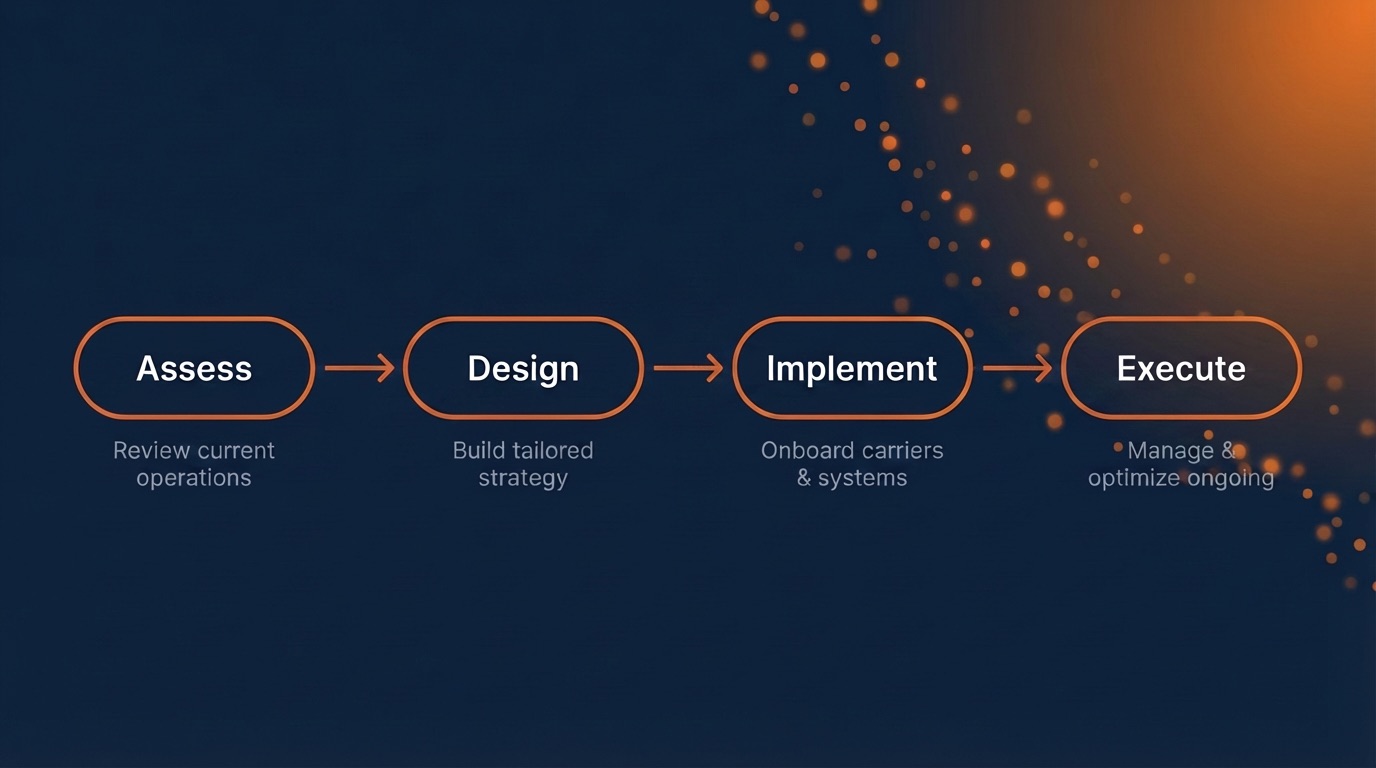
Implementation follows four phases: the provider assesses current operations; designs a tailored solution covering network strategy, technology, and SOPs; implements the program by onboarding carriers and connecting systems; then enters ongoing execution with regular performance reviews. We’ve found that shippers who invest in a thorough assessment phase see faster time to value.
Comparison With Other Logistics Models
Managed transportation is often confused with freight brokerage, in-house teams, 4PL providers, and standalone TMS. Here is how they differ.

| Model | How It Differs | When It Fits |
| Freight Brokerage | Transactional: brokers match individual loads without a long-term strategy. | Spot shipments or supplemental capacity. |
| In-House Team | Internal staff manages carriers, TMS, and reporting. Requires significant hiring and overhead. | Very large shippers with dedicated logistics departments. |
| 4PL / LLP | Manages multiple 3PLs and oversees the entire supply chain strategy at a higher level. | Enterprise-level, multi-provider supply chains. |
| Standalone TMS | Software-only: planning tools but no execution, carrier management, or human support. | Teams with logistics expertise who only need technology. |
An ARC Advisory Group survey found that shippers who stopped using managed transportation estimated their freight costs would rise by 12% or more—illustrating why MTS often outperforms standalone tools or internal teams.
Benefits of Managed Transportation Services
Managed transportation delivers measurable improvements across cost, service, visibility, capacity, and internal workload.
- Cost control: Optimized carrier selection, consolidation, and invoice auditing reduces per-shipment costs and improves spend visibility.
- Better service levels: Dedicated teams monitor every shipment, improving on-time in-full (OTIF) rates and catching exceptions before they escalate.
- Increased visibility: Real-time dashboards and KPI tracking give leadership a clear performance picture.
- Broader access to capacity: A vetted carrier network provides reliable capacity across modes, even during peak seasons.
- Reduced workload: Handing execution and billing to a partner frees your team to focus on growth. We see this consistently—when logistics stops being a daily fire drill, strategic initiatives move faster.
Challenges and Limitations
MTS is powerful, but understanding potential challenges helps set realistic expectations.
- Upfront onboarding effort: Transitioning requires data cleanup, system integration, and SOP alignment—an investment that pays off but takes coordination early on.
- Change management: Internal teams and carriers may need to adjust to new processes and workflows.
- Provider dependency: Without clear governance and data ownership, over-reliance on a single provider can become a risk.
- “One-size-fits-all” risk: Avoid providers who force rigid solutions rather than designing around your operation.
- When MTS may not fit: Very low-volume shippers or organizations with highly specialized regulatory constraints may find other models more suitable.
Considerations for Selecting a Provider
Choosing the right managed transportation partner is one of the most consequential logistics decisions a business can make.
Key Evaluation Criteria
Evaluate providers on industry experience, technology capabilities, carrier network breadth, account management structure, and proven results. Look for a provider that designs around your operation, not a generic template.
Questions to Ask Potential Providers
- What does onboarding look like, and what should we expect in the first 90 days?
- What TMS platform do you use, and how does it integrate with our systems?
- How are carrier rates negotiated, and who owns those contracts?
- What does your reporting and KPI framework include?
- How do you handle exceptions and escalations?
- Will we have a dedicated account team?
- How do you measure and communicate ROI over time?
Conclusion
Managed transportation services give growing businesses a structured way to run freight operations without building a full logistics department from scratch. MTS replaces fragmented processes with a coordinated program that delivers lower costs, better service, and full visibility.
We wrote this guide because we believe shippers deserve a clear, practical understanding of what managed transportation involves—beyond the marketing language. At Alpha Zero Logistics, we’ve built our Managed Transportation Services around the belief that transportation should be a system to be designed, not a cost to be chased. If your network has outgrown spreadsheets and transactional brokers, talk to our team today to start the conversation.
Sources
- Research and Markets. Managed Transportation Services Market Report. researchandmarkets.com
- Grand View Research. Transportation Management System Market Report. grandviewresearch.com
3. ARC Advisory Group. Managed Transportation Services Market Research. arcweb.com